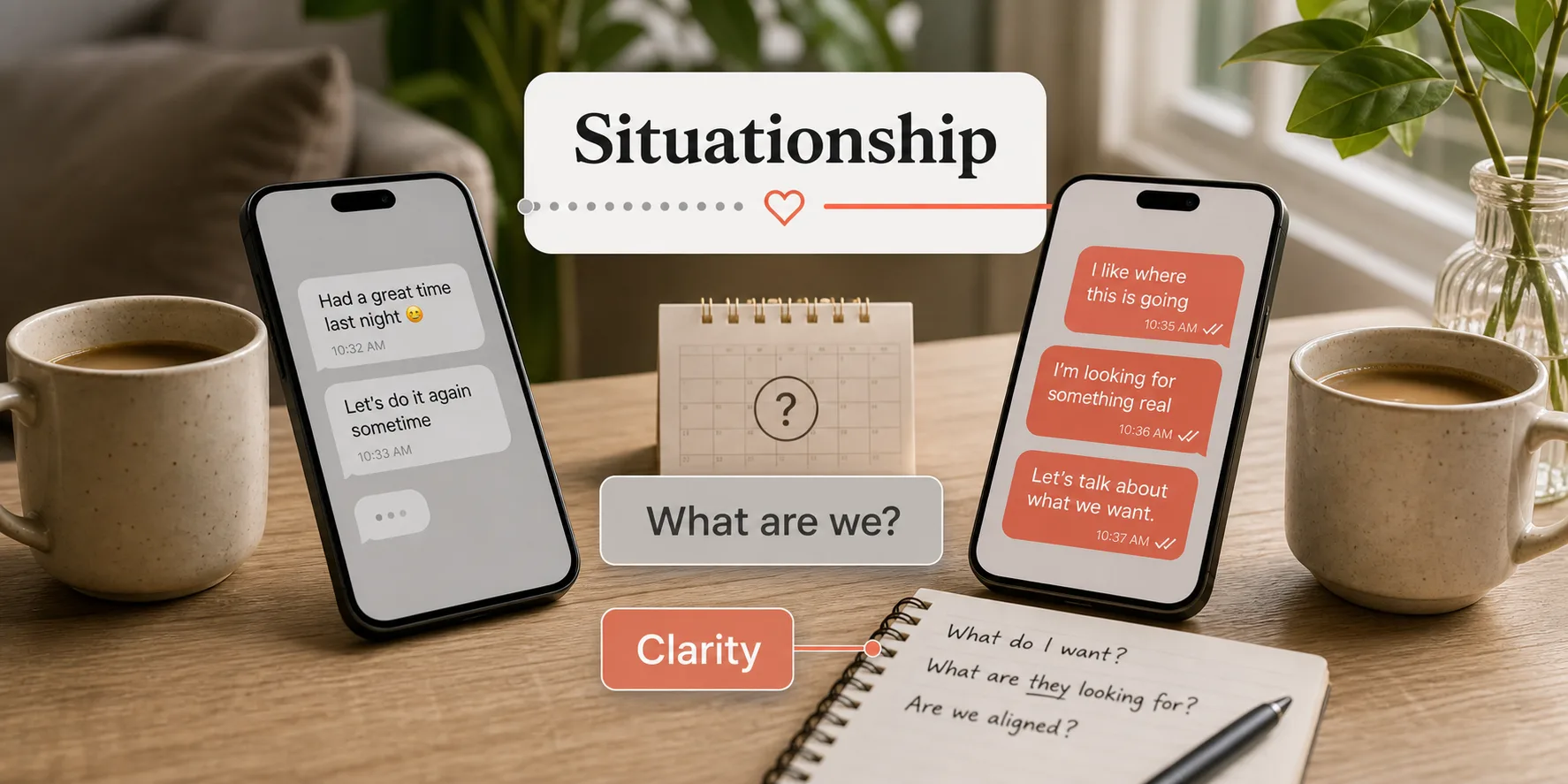
A situationship is a romantic or sexual connection that feels like more than casual dating but is not clearly defined as a relationship. If you searched "situationship" or "what is a situationship," you probably want to know whether your connection is normal, whether it is hurting you, and what to say next.
Short answer: a situationship is defined by ambiguity. There may be texting, dates, sex, emotional closeness, jealousy, or couple-like behavior, but no clear agreement about commitment, exclusivity, labels, or the future.
Quick Answer
| Question | Answer |
|---|---|
| Situationship meaning | A romantic connection without clear labels, commitment, or shared expectations. |
| Main sign | You feel close, but you still do not know where you stand. |
| Can it be healthy? | Yes, if both people want the same level of casualness and communicate honestly. |
| When it becomes unhealthy | When one person wants more and the other keeps the connection vague. |
| Best next step | Ask for clarity directly, then believe the answer and the behavior. |
Jump to a Section
- What is a situationship?
- Situationship signs
- Situationship vs relationship vs casual dating
- Why situationships feel so addictive
- Is a situationship bad?
- What to do if you are in a situationship
- What to say to define the relationship
- How to avoid the next situationship
What Is a Situationship?
A situationship is a connection that has some ingredients of a relationship but not the structure of one. You may text every day, sleep together, go on dates, meet each other's friends, or feel emotionally attached. But the actual agreement is unclear.
Relationship therapist Amanda Lambros told Body+Soul that a situationship involves regular contact and emotional intimacy, but no clear agreement about commitment, exclusivity, or future direction. That is the useful core definition: the problem is not affection. The problem is ambiguity.
Verywell Mind describes situationships as romantic connections without clear labels or commitments, where people may enjoy intimacy while keeping personal freedom. That freedom can be good when both people want it. It becomes painful when only one person is pretending to be fine with it.
Situationship Signs
You are probably in a situationship if the connection has emotional weight but no clear container.
Common Signs
- You spend time together like a couple, but nobody calls it a relationship.
- You avoid asking direct questions because you fear the answer.
- Plans happen last-minute more often than intentionally.
- They act affectionate in private but vague in public.
- You do not know whether you are exclusive.
- You feel anxious after good moments because nothing is defined.
- You keep telling friends, "It's complicated."
- The connection has been going on for months without progress.
- You feel like you are auditioning for a role you already perform.
One sign matters more than all the others: you cannot explain the relationship simply without editing the truth.
Situationship vs Relationship vs Casual Dating
The easiest way to understand a situationship is to compare it with other dating dynamics.
| Dynamic | What it means | Main difference |
|---|---|---|
| Situationship | Romantic or sexual connection with unclear expectations. | Ambiguity is the defining feature. |
| Relationship | Mutual commitment with agreed expectations. | Both people know what they are building. |
| Casual dating | Low-commitment dating that is openly casual. | It can be healthy if both people are honest. |
| Friends with benefits | Friendship plus sex, usually without romantic commitment. | The friendship and physical boundary are more explicit. |
| Talking stage | Early dating before expectations are known. | Normal at first, but not forever. |
The timeline matters. Two weeks of uncertainty can be normal. Six months of uncertainty usually means the uncertainty is the arrangement.
Why Situationships Feel So Addictive
Situationships can feel intense because the reward is inconsistent. You get enough affection to stay hopeful, then enough distance to feel insecure.
Dating coach Matthew Hussey has described this kind of pattern as similar to a slot-machine effect: unpredictable emotional rewards can keep people hooked. You are not only attached to the person. You are attached to the possibility that the next message, date, or confession will finally make everything clear.
That is why a situationship can feel harder to leave than a clean breakup. A breakup gives you an ending. A situationship keeps offering almost.
Werde nicht mehr geghostet.
Verwandle deine beiläufigen Selfies in nur 2 Minuten in Top 1% Dating-Profile. Hol dir die Matches, die du wirklich verdienst.


- Kostenlos umsehen und ausprobieren
- Ergebnisse oftmals direkt in Minuten
- 26 Profi-Styles per Klick
Is a Situationship Bad?
A situationship is not automatically bad. It can be fine when both people are honest, emotionally steady, and genuinely want the same level of casualness.
It becomes bad when the structure benefits one person and destabilizes the other.
A Situationship May Be Healthy If:
- Both people know it is undefined.
- Nobody is secretly hoping the other person will change.
- You feel calm, not constantly activated.
- You can talk about boundaries.
- You are free to date other people if that is the agreement.
- Your self-worth is not tied to getting chosen.
A Situationship Is Probably Hurting You If:
- You keep checking your phone for reassurance.
- You feel embarrassed explaining it to friends.
- You want commitment but pretend you do not.
- You accept crumbs because the chemistry is strong.
- You feel anxious after intimacy.
- You are afraid that asking for clarity will end it.
Verywell Mind notes that situationships can become stressful when expectations differ, especially for the person who wants more commitment. That is the emotional risk: the relationship may be casual on paper, but not casual in your nervous system.
What to Do If You Are in a Situationship
You have three real options: keep it casual, define it, or leave it. The wrong option is pretending you do not care while quietly hoping the other person changes.
Option 1: Keep It Casual
Choose this only if it is true. Not because you are afraid to ask for more.
Keeping it casual works when you can say:
- I enjoy this connection as it is.
- I am not waiting for a relationship.
- I feel emotionally steady.
- I can date other people without guilt or panic.
- I do not need more consistency from this person.
Option 2: Ask for Clarity
This is the right move if you want a relationship, exclusivity, more consistency, or simply an honest answer.
You are not "needy" for asking. You are making an adult decision about your own emotional life.
Option 3: Leave
Leave if the answer is vague, the behavior does not change, or the connection keeps making you feel smaller.
The hardest part is accepting that confusion can be an answer. If someone wants the benefits of closeness but avoids the responsibility of clarity, that is information.
What to Say to Define the Relationship
Do not over-explain. The goal is not to convince someone to value you. The goal is to find out whether they can meet you.
If You Want a Relationship
I like spending time with you, and I am interested in seeing whether this can become an actual relationship. Is that something you want too?
If You Want Exclusivity
I am not comfortable continuing in a grey area. If we keep seeing each other, I would want us to be exclusive. How do you feel about that?
If You Want to End It
I have enjoyed parts of this, but the uncertainty is not working for me anymore. I am looking for something clearer, so I am going to step back.
If They Give a Vague Answer
I hear you. I do not want to pressure you, but I also do not want to stay in something undefined. I am going to make choices based on what I need.
The right person may need a conversation. They should not need months of emotional negotiation to decide whether they want to treat you with clarity.
How to Avoid the Next Situationship
The best way to avoid another situationship is to create clarity earlier, before attachment outruns information.
Use Earlier Filters
- Ask what they are looking for before the third date.
- Notice consistency, not just chemistry.
- Watch whether their actions match their words.
- Avoid people who mock labels but expect relationship benefits.
- Do not use sex, patience, or emotional labor as an application for commitment.
Dating app profiles can also help. If your photos and bio only communicate "fun and attractive," you may attract people who respond to vibe but not intention. If you want clarity, your profile should signal warmth, confidence, and what kind of connection you are open to.
For better first impressions, start with dating profile photo mistakes, then use RadiantSnaps if your photos need a cleaner, more intentional look. Strong photos will not prevent every situationship, but they do help you attract people who take your profile seriously from the start.
Final Verdict
The situationship meaning is simple: it is a romantic connection without clear commitment, labels, or direction. The emotional reality is more complicated. A situationship can feel exciting, intimate, and hopeful, but it can also keep you waiting for clarity that never comes.
If you are happy with the arrangement, communicate boundaries and enjoy it honestly. If you want more, ask directly. If the answer stays vague, choose yourself before the ambiguity becomes your normal.
The goal is not to force every connection into a relationship. The goal is to stop calling confusion chemistry when what you really want is clarity.
Sources
- Verywell Mind on situationships - definition, pros and cons, emotional impact, and expert commentary from Sabrina Romanoff, PsyD.
- Vogue on what a situationship is - definition, examples, and how to communicate about an undefined connection.
- New York Post / Body+Soul on situationships - 2026 expert discussion of ambiguity, emotional intimacy, and why people stay.
- El Pais on situationships - reporting on situationships, dissatisfaction, and relationship ambiguity.
Häufig gestellte Fragen
- What is a situationship?
- A situationship is a romantic or sexual connection that has intimacy, regular contact, or emotional closeness but no clear agreement about commitment, exclusivity, labels, or the future.
- How do I know if I am in a situationship?
- You may be in a situationship if you act like a couple sometimes but avoid labels, do not make future plans, feel anxious about where you stand, and cannot explain the relationship clearly to friends.
- Is a situationship always bad?
- No. A situationship can work if both people genuinely want something casual and communicate honestly. It becomes unhealthy when one person wants commitment, feels anxious, or keeps waiting for clarity that never comes.
- Can a situationship turn into a relationship?
- Yes, but only if both people want the same thing and are willing to define expectations. A situationship does not become a relationship through patience alone; it needs a direct conversation and mutual action.
- How do you end a situationship?
- End a situationship by naming what you want, asking whether the other person can meet you there, and stepping away if the answer is unclear or inconsistent. Keep the message direct, kind, and firm.