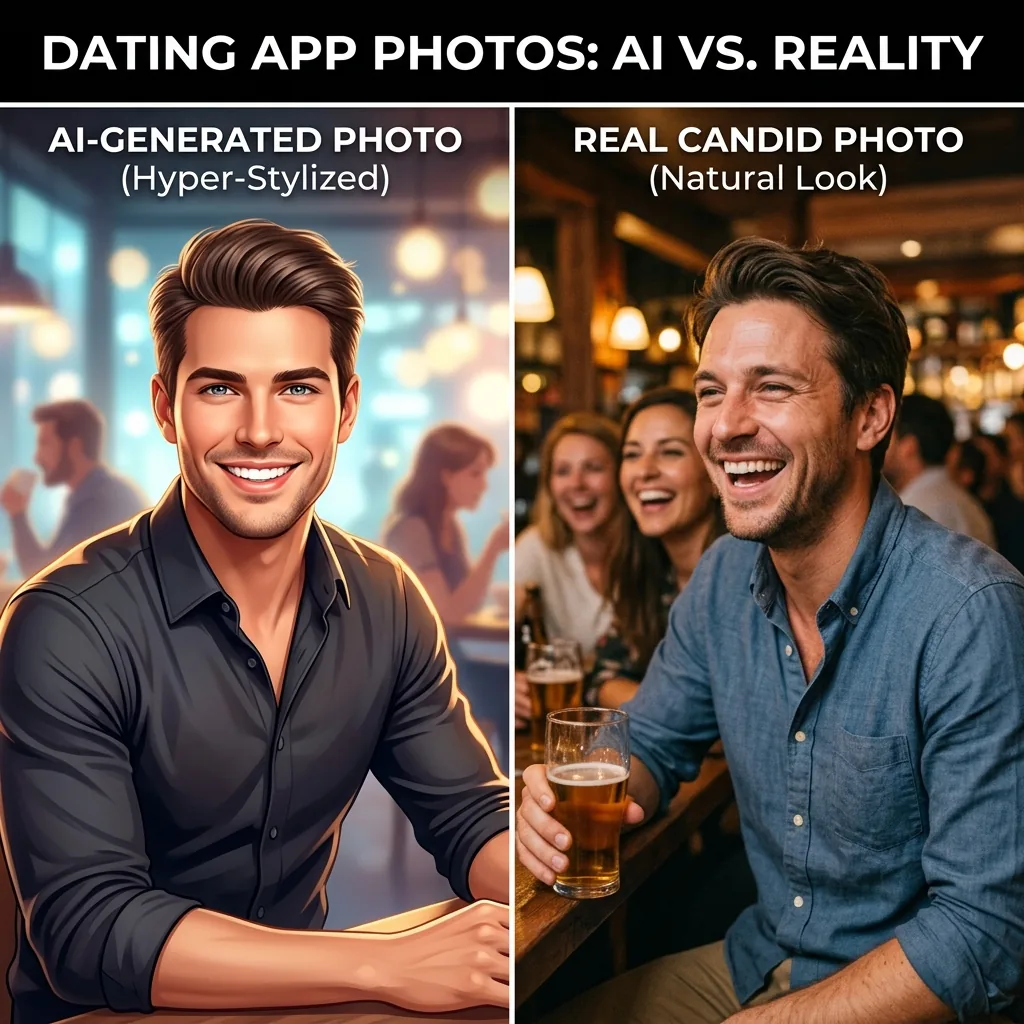
AI photos and dating apps have reached an awkward stage in 2026. On one side: Match Group and Kinsey Institute data shows nearly 40% of American singles (67% of Gen Z) already use AI in their dating lives. On the other: r/OnlineDating gets a fresh "how do I tell if this photo is AI" thread every single week. This article doesn't pick a side — it maps the line the community itself has settled on, and where AI photos catfishing actually begins.
The One-Sentence Version
Enhancing is fine. Fabricating is not.
The test that's emerged from hundreds of Reddit threads is almost embarrassingly simple:
Show the photos to a friend in real life. If they instantly recognize you, you're safe. If they don't, you've crossed into fabrication.
Expanding on it: fixing the lighting, sharpening the focus, swapping in a clean real-world background — that's "you on a good day," and it's widely accepted. Changing your face shape, body, skin tone, or height, or generating a luxury setting you've never set foot in — that's a fictional person, it detonates at the meetup, and the community files it straight under catfishing.
Why Users Draw the Line, Not the Platforms
A common misconception is "dating apps ban AI photos." The reality:
| Platform | Official stance on AI photos | The actual red line |
|---|---|---|
| Tinder | Terms don't prohibit AI-generated content | Prohibits misrepresentation — photos that don't match you; Face Check biometric verification rolling out for flagged accounts |
| Hinge | AI content allowed if it shows your real appearance | Deployed AI photo detection in late 2024 |
| Bumble | Not explicitly banned | Misrepresentation prohibited, human review driven by reports |
The common denominator across all three: what gets penalized is misrepresentation, not "the photo passed through AI." Taking your honest 6/10 and optimizing it to a 7.5 stays inside the rules. Generating a 9 from a 4 is a violation, and a report can get you banned.
The real judge, though, is the person you matched with. Ten matches, nine who think you look good, zero reports — the system never looks at you. The moment one person meets you, feels the photos were bait, and taps report, the process starts.
Detection Tech in 2026: It Can Spot AI — but Spotting Isn't Punishment
MIT Technology Review's 2026 reporting puts mainstream platforms' AI image detection accuracy at about 73% — roughly one AI photo in four gets flagged by the technology. But between "flagged as AI" and "throttled or banned" sits one decisive variable: whether multiple people have reported the photos as not matching the person.
Also worth knowing: detection is improving fast, and two categories already get caught far more often than 73%:
- Free-tool output. Plastic skin, background lighting that contradicts the face, wrong finger count, over-smoothed features — experienced users spot these on sight, and r/Bumble has threads specifically teaching people how to identify AI photos
- Full face-swap deepfakes — an AI face pasted onto someone else's body. In 2026, one TikTok video exposing the same "AI men's wardrobe" (identical flannel shirt, linen pants, beach backdrop) recycled across multiple fake accounts pulled 1.2M+ views and pushed every platform to tighten verification
The takeaway: whether you get caught is increasingly a function of your tool's quality, not of AI itself.
Four Ethical Rules the Community Settled On
Compressed from dozens of Reddit threads, these work as a direct checklist:
- The photo looks like you — not a retouched celebrity version of you, the actual you
- Enhance what's already there — lighting, sharpness, and background are fair game; bone structure, body, and skin tone are not
- Run the friend blind test — if someone who knows you can't recognize it, you've crossed the line
- Be ready to own it — multiple users report that casually saying "the photos are AI-polished" builds more trust than pretending they're raw camera files
Rule 2 is also the dividing line between product categories. The market splits into tools that optimize your real photos (RadiantSnaps, Facetune-style apps) and tools that invent a new face from nothing (general text-to-image models). The first category sits inside the line by construction; the second walks toward the line by design.
Which Tools Stay Inside the Line
| Tool type | Examples | Keeps your real features? | Community reputation |
|---|---|---|---|
| AI photos built on real selfies | RadiantSnaps | Yes — generated from your own selfies | "Looks like me on a good day," passes photo verification |
| Light editing apps | Facetune, AirBrush | Yes | Fine for touch-ups; overdone, it shows too |
| General text-to-image | Midjourney, Stable Diffusion | No — prompted from scratch | Clearly unsuitable for dating photos, near-certain violation |
| Free one-tap AI generators | Various | Partially | Plastic skin plus background flaws — where blowups happen |
The problem with free tools isn't that "paid is better value." It's that output quality directly decides whether you cross the line: in r/SwipeHelper, the success stories (matches going from 1–2 a week to 20+) all come from paid-tier tools that preserve the real face, while the blowups are uniformly free tools that produced "a different person."
If you're choosing a tool, the only criterion that matters is the friend blind test. Tools like RadiantSnaps — built on real selfies with similarity preservation as the core feature — stay inside the line by design. Try one photo of yourself on the generate page, show a friend, then decide.
The Working Mix: AI Photos Plus Real Photos
The pattern that actually survives contact with reality isn't "AI everything":
- AI-optimized photos as the lead and main shots (fixing the lighting, background, and composition problems selfies can't)
- Keep 1–2 genuine life photos (hobby scenes, shots with friends — proof you exist)
- An honesty buffer before the date: once the conversation is warm, suggest a quick video call. It clears photo anxiety for both of you at once
This mix serves both goals: visual competitiveness in the swipe feed, and credibility at the meetup. Dating ends offline — AI photos win you the chance to meet in person; the real you handles everything after that.
Three Blowups Worth Learning From
Cases teach better than principles. The three failure patterns that keep recurring, by frequency:
Case 1: free tools, full replacement. A user ran nine photos through a free generator and replaced his entire profile. Great swipe-stage numbers — until matches started opening with "did you draw these?" Plastic skin, one uniform light direction, background blur artifacts: veterans clocked every one. Lesson: free tools are for testing; real use requires a paid tool that preserves real skin texture.
Case 2: the persona overflowed. Luxury car, first class, Michelin tables — every scene borrowed. One match asked "so is the car yours?" and the whole thing collapsed. Lesson: your scenes should look like your actual weekends. The more expensive the persona, the higher the cost of meeting it.
Case 3: new face, old body. AI-optimized close-ups with the original full-body shot untouched. The meetup gap still hit, because people judge whole-body consistency. Lesson: optimize the full set, and keep the body shots honest.
The AI Artifact Checklist
Run every AI photo through this table before uploading; fail any row and regenerate:
| Check | Pass standard | Common giveaway |
|---|---|---|
| Skin texture | Pores, real texture | Plastic sheen, over-smoothing |
| Hair edges | Natural transition into the background | Blurry halo, color banding |
| Hands | Five fingers, natural joints | Extra fingers, fused fingers |
| Light direction | One consistent source across the frame | Face lit left, background lit right |
| Eye catchlight | Natural catchlight present | Dead eyes, odd pupil shapes |
| Background logic | Scene is realistic and coherent | Garbled text, broken perspective |
| Likeness | A friend recognizes you instantly | "Hotter than the actual person" |
This table doubles as a tool evaluation sheet: score each generated photo row by row, and only pay for a tool that passes everything consistently. That's exactly how to evaluate RadiantSnaps — generate one free photo on the generate page, check it against the table, then decide about the full set.
Frequently Asked Questions
- Are AI photos allowed on Tinder?
- Yes, if they keep your real features. Bans trigger on repeated reports that "photos don't match the person," not on "photos were AI-processed." Face Check biometric verification checks that it's really you — it doesn't check whether the photo was optimized.
- Can other people tell my photos are AI?
- Depends on the tool. In 2026 users spot free-tool output at a high rate (skin texture, background flaws), while high-quality AI photos generally pass blind tests. The more your photos look like "your actual Tuesday," the less anyone wonders.
- Do AI dating photos count as catfishing?
- By community consensus: optimizing lighting and how you present doesn't, inventing a face you don't have does. The first is wearing a well-fitted outfit to the date; the second is wearing a mask.
- What happens if the gap shows up at the meetup?
- It's the worst-case outcome and it's fully preventable — hold the likeness line, and clear the uncertainty with a video call before meeting. Case after case shows that "photos slightly better than reality" plays fine, while the reverse gap is fatal.
- Which photo features give away AI generation most often?
- Over-smoothed skin, fuzzy hair-background transitions, contradictory light direction, abnormal fingers, and scrambled accessory details. The entire selling point of quality tools is getting those five things right.
- How much do AI photos cost?
- Free trial plus a paid plan is the standard model — RadiantSnaps runs about $29–$39 a month, while a professional dating photographer charges $200–500 per session. For most people the lowest-risk path is generating one free photo to verify the likeness before paying anything.
- Do AI photos actually raise your match rate?
- r/SwipeHelper user reports show 2–3x match-rate jumps after switching to competent AI-optimized photos are common — provided the photos pass the blind test and the rest of the profile has no glaring holes.