Dating Over 40 (and 50): Why the Apps Are Different and Why IRL Is Back
Dating over 40 isn't a story about people giving up on apps. It's a story about a crowd using a completely different set of apps, with a completely different set of worries. Pew Research Center's 2023 survey of 6,034 US adults found that among online daters aged 50 and up, 50% had used Match against just 11% who'd used Tinder, and that 41% of over-30s had paid for a dating platform versus 22% of under-30s. This piece takes those first-party figures, a batch of real forum threads captured live on 2026-11-09, and the official fraud statistics to map where dating over 40 actually gets stuck, why meet people offline is genuinely back in fashion, and what a safe, low-key first date looks like when you've been out of the game for a while.
Cover: a conceptual image, no statistics embedded. Every figure in this article traces back to a first-party report, a third-party snapshot or an official document listed under Sources and caveats.
The short version: dating over 40 is a different game, not an exit
- People in this bracket aren't offline - they're on different apps. Pew's first-party data puts Match at 50% and Tinder at 11% among online daters aged 50+, a gap of nearly five to one, and over-30s paying at 41% against 22% for under-30s. Treating "older" as a synonym for "not online" is simply wrong.
- The fastest-growing corners are small communities, not the giant ones. A third-party snapshot has r/WomenDatingOverForty at +6.2% and r/datingoverfifty at +4.4% month on month, while r/dating_advice (4.901M) and r/Tinder (5.971M) are close to saturated. Hold that thought with a caveat: it's a third-party snapshot, roughly a month behind, not Reddit official statistics.
- The conversation isn't "how do I get more matches". It's "is this person real", "should I just quit", and "where do I actually go to meet someone". One newly divorced 60-year-old asking whether a coffee date was a scam pulled 435 comments - hotter than almost any optimisation guide.
- The IRL comeback is real, but it isn't a cure-all. Brunch dates, hobby groups and cold-approach threads are genuinely rising, and "not everyone should go offline" needs saying out loud, with safety and etiquette boundaries drawn first.
- The one lever you fully hold is your own side. Four recent, honest, recognisable photos, the right first-meeting setting, and the platform's safety tools switched on. None of that guarantees a result, but it cuts down "not what I saw in the photos" and cuts down the odds of being scammed.
Dating apps for over 50: the Pew numbers, read properly
Before any of the forum colour, plant the base in something you can actually check. Pew Research Center published two reports on 2023-02-02 built on 6,034 US adults; they're the most-quoted and most defensible source in this whole discussion. Every number in the table below comes from there, with no content-farm statistics mixed in.
| Measure | Figure | What it actually says |
|---|---|---|
| US adults who've used a dating site or app | 30% (53% of under-30s) | All adults; younger people are still the clear majority |
| Partnered adults who met their current partner online | 10% (7% of all adults; 20% of partnered under-30s; LGB 24%) | The chain does work, just not for everyone |
| Online daters 50+ who've used Match | 50% | The core comparison in this article |
| Online daters 50+ who've used Tinder | 11% | About a fifth of the Match figure, close to a 5x gap |
| Ever paid for a dating platform | 35% overall; 41% of over-30s; 22% of under-30s (men 41%, women 29%) | Older users are roughly twice as likely to pay |
| Think online dating is safe / unsafe | 48% / 49% | Almost a coin flip; risk perception is already split |
| Positive / negative experience among users | 53% / 46% | Positive edges it, but it's hardly a landslide |
| Online daters who've used Tinder / Match / Bumble | 46% / 31% / 28% | All-ages figures, pulled up by younger users |
Source: https://www.pewresearch.org/short-reads/2023/02/02/key-findings-about-online-dating-in-the-u-s/ and https://www.pewresearch.org/internet/2023/02/02/the-who-where-and-why-of-online-dating-in-the-u-s/ .
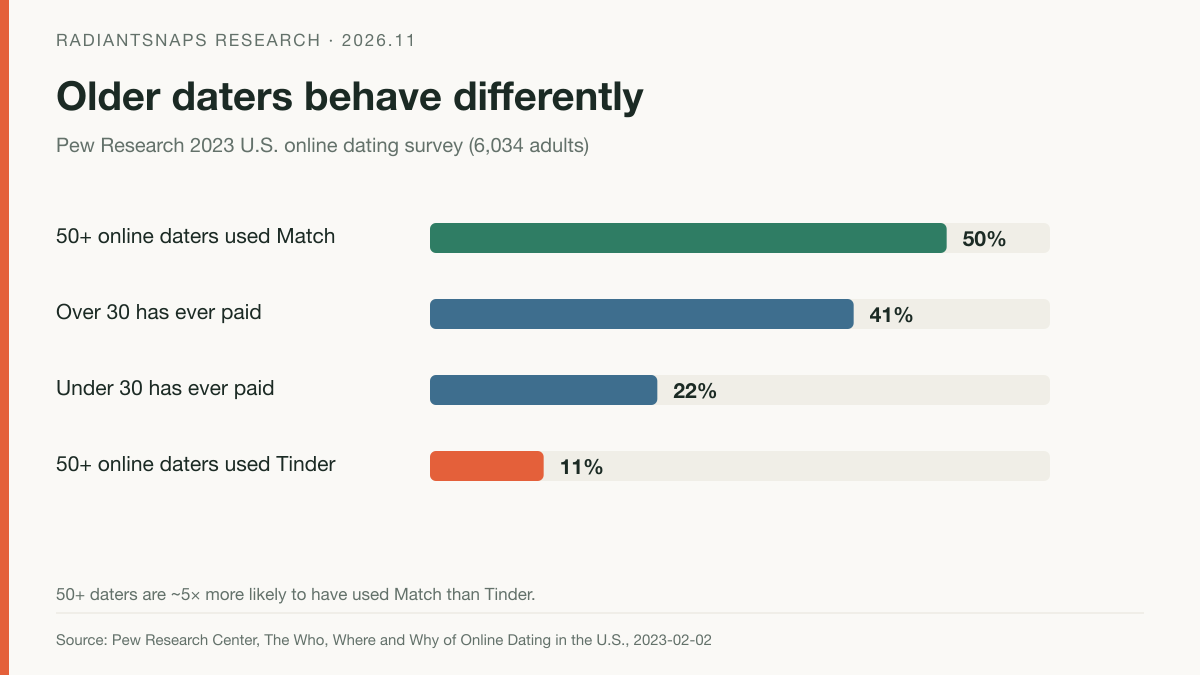
Source: Pew Research Center, 2023-02-02, 6,034 US adults. Chart drawn for this article from the published figures; the source is noted at its foot.
The whole table boils down to one line: older users aren't off the apps, they're on a different set of them. Across all ages Tinder leads at 46%, but zoom in on the 50+ bracket and the picture flips - Match 50%, Tinder 11%. The same group is also more willing to pay (41% vs 22%), which suggests they treat the app as a tool to get a job done, not as something to fiddle with on the sofa.
Three things that gap does and doesn't tell you
First, it's about penetration, not a verdict. 50% and 11% mean "have used", not "are using now" and certainly not "works better". Products aimed at serious relationships, sold on subscription, with an older user base, naturally skew higher in this bracket. Reading it as "everyone over 50 should be on Match" is an overreach; the real choice depends on which app still has live people in your town and what you're looking for.
Second, higher willingness to pay comes with lower tolerance for noise. Someone happy to pay for filtering efficiency usually cares a lot about what happens after the payment: are there real people, is there verification, will it quietly auto-renew? That's why this crowd's complaints about paywalls, bots and fake profiles are so specific. It isn't reluctance to spend; it's reluctance to spend on nonsense.
Third, the risks they care about are different. 48% call online dating safe, 49% call it unsafe. For a 50-something that isn't an abstract attitude, it's three concrete questions: is the photo really them, is this a scam, is the first meeting safe. Pew also recorded 53% positive against 46% negative - only a narrow edge. So the caution people bring to re-entering the market isn't paranoia; in light of the official fraud numbers below, it's proportionate.
A word on the too-neat numbers
You'll see immaculate claims bouncing around AI-dating-photo SEO pages: "1.9 seconds per profile", "52% of swipes decided by the first photo", "34.2% match rate", "272% more matches", "21x date rate", "90% of first impressions come from the photo", "1.8M profiles analysed", "78% or 79% user burnout", "89% photo mismatch", "AI photos 32.8% match rate", "pet photos boost matches 40%". None has a published methodology, an original dataset or a named study behind it. We don't use them, we don't put them in any table, and we don't lean on them as evidence. The only figures we'll stand behind carry an institution, a sample and a release date.
The fastest-growing communities are the small ones
Now the caveat first, then the numbers. Every community size and growth rate below comes from a third-party leaderboard, subriff.com's "top threads this month" snapshot, corresponding roughly to mid-September to mid-October and lagging by about a month. This is not Reddit official statistics and it is not a live 2026-11-09 reading. It's only useful for seeing the structural difference in slope, and it belongs to a different batch from the November live capture below - the two are never added together.
| Community | Members | Monthly growth | Status |
|---|---|---|---|
| r/relationship_advice | 15.887M | - | Third-party subriff snapshot, not official |
| r/dating | 6.273M | - | Third-party subriff snapshot, not official |
| r/Tinder | 5.971M | - | Third-party subriff snapshot, not official |
| r/dating_advice | 4.901M | - | Third-party subriff snapshot, not official |
| r/datingoverthirty | 1.181M | - | Third-party subriff snapshot, not official |
| r/Bumble | 466K | - | Third-party subriff snapshot, not official |
| r/OnlineDating | 257K | - | Third-party subriff snapshot, not official |
| r/hingeapp | 207K | - | Third-party subriff snapshot, not official |
| r/WomenDatingOverForty | - | +6.2% | Third-party subriff snapshot, not official, lags ~1 month |
| r/datingoverfifty | - | +4.4% | Third-party subriff snapshot, not official, lags ~1 month |
Growth is a relative number, not an absolute one. A community of a few tens of thousands gains a few thousand people and that's several percentage points; for a 4.9M-strong community to grow 6.2% it would need roughly 300,000 new members, which is close to impossible. "Fastest-growing" describes the slope, not the size, and certainly not "over-40s have overtaken the under-30s". Pew gives the anchor in the other direction: 53% of under-30s have used a dating platform, far above the 30% of all adults. Read the two together correctly and you get: younger people are still the majority, but the 40+/50+ bracket is the steepest, most under-served pocket of new demand right now.
Three more reasons the energy collects in small rooms. Big communities have gone generic - r/Tinder's monthly top list is almost entirely memes at 11k-15.4k upvotes, while the serious talk sits in r/OnlineDating, r/dating_advice and r/Bumble; in a 4.9M-strong sub a 55-year-old divorcee asking about scams, photos and the cost of an evening gets drowned out by height and "who replies first" threads. Re-entry also tends to be triggered by a life event - divorce, bereavement, kids leaving home, a move - so the questions are remarkably homogeneous: no usable photos, unfamiliar rules, fear of being conned, and an evening that's expensive to waste. A small, like-minded room absorbs that well. And supply has been missing for years: mainstream dating content assumes a 25-year-old reader and talks swiping technique, openers and outfits, almost never "how do I get one decent solo photo after a divorce". Few people write for this crowd and lots of people are asking, so they gather where they can actually be heard.
What the forums are actually asking
Here are the real threads behind this piece, transcribed with their titles, communities, timings and counts. One column convention matters: where the source list gave a direct permalink, we print it; where it only gave a subreddit and title (the 9-10 batch and the inline r/dating_advice list), we locate the thread by community plus title and don't invent a URL.
| Thread | Subreddit | Batch / posted | Heat (upvotes / comments) | Link |
|---|---|---|---|---|
| Newly divorced at 60—is this a scam or a genuine coffee date? Need advice. | r/datingoverfifty | 9-10 third-party snapshot | 274 / 435 | no permalink in source |
| Scams are us...I got robbed version :) | r/datingoverfifty | 9-10 third-party snapshot | 540 / 119 | no permalink in source |
| I'm considering being done with dating forever | r/WomenDatingOverForty | 9-10 third-party snapshot | 131 / 81 | no permalink in source |
| From apps to marriage. Wanted to share our story! | r/hingeapp | 9-10 third-party snapshot | 651 / 67 | no permalink in source |
| "Get off the apps, bro" and go where? | r/dating_advice | 9-10 third-party snapshot | 1.6k / 1.3k | no permalink in source |
| I do not miss dating apps whatsoever. | r/Bumble | November live capture, 6 days ago | - / 636 | https://www.reddit.com/r/Bumble/comments/1xlvamt/i_do_not_miss_dating_apps_whatsoever/ |
| I cold approached a girl sitting with 3 friends. | r/dating_advice | November live capture, 3 days ago | - / 1419 | inline list, no direct link |
| Brunch dates are a game changer | r/dating_advice | November live capture, 7 days ago | - / 220 | inline list, no direct link |
| Cute Girl at Gym keeps showing me her progress pics at random. | r/dating_advice | November live capture, 16 days ago | - / 1001 | inline list, no direct link |
| Did Tinder get much worse or did I age out of it? | r/OnlineDating | November live capture, 17 days ago | - / 113 | https://www.reddit.com/r/OnlineDating/comments/1xcspgr/did_tinder_get_much_worse_or_did_i_age_out_of_it/ |
| 53/M looking for Help | r/hingeapp | November live capture, 11 days ago | - / 58 | https://www.reddit.com/r/hingeapp/comments/1xi0290/53m_looking_for_help/ |
| Why is online dating in America so difficult? | r/OnlineDating | November live capture, 22 days ago | - / 146 | https://www.reddit.com/r/OnlineDating/comments/1x8l2xz/why_is_online_dating_in_america_so_difficult/ |
| Hinge worked for me! | r/hingeapp | November live capture, 24 days ago | - / 40 | https://www.reddit.com/r/hingeapp/comments/1x70byq/hinge_worked_for_me/ |
| Dating Apps Are Dying | r/technology | 2026-09 landmark thread | - | https://www.reddit.com/r/technology/comments/1wd8dnz/dating_apps_are_dying/ |
Read the "November live capture" rows as a 2026-11-09 snapshot of each subreddit's /top/?t=month taken in a local Chrome session: every upvote and comment count is a snapshot of discussion volume from that date, not a measure of how often anything happens, and it will keep moving. The "9-10 third-party snapshot" rows come from subriff.com, lag roughly a month, are not Reddit official statistics, and are never combined with the November figures. All "N days ago" values are relative to 2026-11-09. In that r/technology thread, u/Ragegasm's line about "loot boxing loneliness through a swiping algorithm" and u/stormblaz's gripe about paywalls, an ad every three swipes and OnlyFans funnel bots are user opinion, not a finding - we cite them the same way as everything else here, as sentiment.
Four threads run through the table. Scam anxiety is the hardest one: "Newly divorced at 60—is this a scam or a genuine coffee date?" at 435 comments and "Scams are us...I got robbed version :)" at 119 both come from 50+ communities, and they line up exactly with Pew's 48% / 49% split. Quitting is now a legitimate position: "I do not miss dating apps whatsoever." (636), "I'm considering being done with dating forever" (81) and "Get off the apps, bro" and go where? (1.3k) - and the emphasis in that last one is on "go where?", which is precisely where the IRL comeback starts. Success stories are rare but treasured: "From apps to marriage. Wanted to share our story!" (651) and "Hinge worked for me!" (40) get saved and re-read in an ecosystem built on complaints. Offline has moved from slogan to practice: 1419 comments on the cold approach, 220 on "Brunch dates are a game changer", 1001 on the gym thread, all inside a 4.9M-strong r/dating_advice.
Meet people offline: what the IRL comeback actually looks like
"Go offline" isn't just a mood. It has fairly concrete shapes, so here's the side-by-side before we talk boundaries.
| Dimension | Online (in the app) | Face to face (IRL) |
|---|---|---|
| How you get in | Algorithmic suggestions, swiping, matching | Hobby groups, brunch, markets, exhibitions, friends, a normal approach in the wild |
| First impression comes from | A photo plus a couple of lines | The actual person, their voice, how they behave, the shared setting |
| Matching threads | "Did Tinder get much worse or did I age out of it?" (113), "Dating Apps Are Dying" | "I cold approached a girl sitting with 3 friends." (1419), "Brunch dates are a game changer" (220), "Get off the apps, bro" and go where? (1.3k) |
| What it's good at | Filtering, async chat, kinder to shy people, reaches beyond your postcode | You can see it's really them, the setting supplies the conversation, no algorithm and no paywall |
| What it costs | Catfish photos and bots, messages into a void, paywalls, fragmented evenings | Needs a time and a place, rejection happens in person, a higher bar for introverts, safety and manners are on you |
| Why it matters over 40 | Higher payment rate (41%), more sensitive to verification and noise | Decades of social practice, more used to "sit down and talk", daytime suits the routine |
Brunch keeps coming up for a reason: daylight, a public place, a natural end point, a bill you can control, no pressure to drink - it hits the safety and dignity requirements of this bracket at the same time. Hobby groups do the same thing - hiking, a book circle, a cookery class, a dog meetup - by downgrading "find a partner" to "do a thing together", which lowers the stakes and lets you watch how a real person talks, treats the staff and handles a small hiccup. For a crowd with a thin photo library and a sharp nose for a dodgy picture, the most useful thing about meeting offline is simpler than all of that: you don't have to trust a photograph first.
Not everyone should go offline
This needs saying honestly, or the IRL comeback just becomes another lecture. For several groups, keeping an app as the main channel is entirely reasonable: people who are introverted or socially anxious, for whom async messaging is protection rather than a limitation; people in small towns, with mobility issues, caring responsibilities or shift patterns, where the supply of offline events is thin to begin with; LGBTQ+ people and niche-interest groups in areas with few safe physical spaces, where online is often the only workable door; and anyone freshly divorced and still finding their feet, who may not want to be seen in a room full of acquaintances yet. A large share of those 1.3k replies to "Get off the apps, bro" and go where? is exactly "there's nowhere near me to go". So the accurate version is: offline adds a road, it doesn't order everyone off the apps.
Safety and etiquette before you head out
- Keep the first meeting to daylight, somewhere public and easy to leave on your own terms - a cafe, brunch, a market, an exhibition - and make your own way there and back, never in their car.
- Tell one friend the time, the place and a screenshot of the profile; keep the chat inside the app at first, and don't hand over your address, workplace or financial details.
- Don't block a path, don't follow someone, and don't cut in when they're plainly busy - headphones in, rushing, working, paying. In a group setting, join the conversation normally rather than locking onto one person.
- If they say no, check their watch, lean back or go quiet, end it there and leave politely - no asking why, and no treating "can I at least get your number" as a consolation prize.
- Make the invitation low-stakes and easy to decline: a specific time, a specific place, and "come if it suits, no problem if not".
- Anything that asks for money, a verification code, an investment, a transfer, or insists on moving to a private chat app is a hard stop. That's true online and off, but face to face the awkwardness of refusing in person makes it worth setting the rule in advance.
Match vs Tinder over 50, and the "best dating app over 50" trap
Search for the best dating app over 50 and you'll get a confident single answer from every listicle. The data doesn't support one. Pew's 50% vs 11% is a comparison of "have ever used" between two products in the 50+ bracket, not a head-to-head trial and not a recommendation. It tells you the two apps have very different reach in this age group; it doesn't tell you Match vs Tinder over 50 is a contest one of them wins, and it certainly doesn't say which has active people in your area. The honest answer to "best dating app over 50" is: whichever one still has real, local, responsive people for what you're after - and Pew's 41% payment rate among over-30s is a hint that this crowd will pay for decent filtering, not that a pricier tier works better.
Two practical cautions follow. Don't read "used" as "suited to me", and don't spread yourself across five apps at once - one platform, one short window for messages each day, is kinder to an evening that's already expensive. Dating after divorce at 50 lands on exactly this point: the rules, the subscription tiers, the verification steps and the message etiquette have all changed since the last time you did this, and trying to relearn all of them simultaneously is how a fortnight disappears. Pick one, give it two weeks, adjust one photo or one opening line rather than throwing more money at it.
Where re-entering really gets stuck: four pain points, and the number behind them
The complaints aren't scattered. They cluster in four very specific places, and none of them is fixed by swiping more.
| Pain point | How it shows up | Why it hits harder here | What to do first |
|---|---|---|---|
| A thin photo library | The phone holds old group shots, wedding and family photos, or a blurry cropped half-face; no recent, solo, clear headshot, and old couple photos feel wrong after a divorce | Photos taken before smartphones mostly live in albums or someone else's phone; nobody has prepared "one good picture of just me" for years | Rebuild to the four-photo structure, prioritising shots from the last 12 months |
| The time cost of re-entry | Relearning swiping, tiers, verification and message pacing, while also handling a changed name, address and social circle | The last serious dating run may be fifteen years ago; work, kids and elder care fill the week, so a wasted evening costs far more than it did at 25 | One platform, one fixed short slot for messages; don't hand the whole evening to the app |
| Extra sensitivity to "not the photo" | Cares a lot about whether the person in the picture turns up, and won't waste a night on a mismatch | Meeting is costly and the goal is clearer - a steady relationship, not volume - so tolerance for being misled is low | Be verifiable yourself: recent, lightly retouched, at least one full-body shot; build verification into the first meeting |
| Higher scam exposure | Romance scams dressed as a sincere partner, investment and crypto pitches, faked video calls | Backed by official figures below; assets tend to be concentrated, social support can be thinner, and the new technical patter is unfamiliar | Never transfer money, don't tap external links, use platform verification and reporting, get a third party to sanity-check any large decision |
The risk has an official number, not just a feeling
This one can't be waved through with "it feels common". US Senate Report 119-58 (2025-09-02, an official govinfo document), discussing romance scams, cites the FBI's Elder Fraud Report: in 2023, more than 6,700 victims aged 60 and over lost close to $367 million. The same report records that in 2024, 59,000+ consumers reported romance-scam losses to the FTC of nearly $1.2 billion, with a median loss of $2,000, and that in 2023 a further 64,000+ Americans lost over $1 billion. Be precise about the status: these are FBI / FTC official statistics quoted inside a Senate report, not forum chatter and not our estimate.
That is exactly why "is this coffee date a scam?" drew 435 comments in a 50+ community. It isn't suspicion; it's a reasonable response to a documented risk. It's also why "pick a daylight, public place for the first meeting" and "switch the platform's safety features on" aren't polite filler in this article - they're the two things this group should do first.
What you control and what you don't
Here's the whole piece in one sentence: do your own side well; buying something doesn't come with a person attached.
| What you control | What you don't |
|---|---|
| Whether your photos are recent, clear and still look like you, and whether the four-photo set is complete | Whether they open your profile, reply, or how fast |
| Whether the profile says what you're looking for and offers one easy thing to pick up | Whether the algorithm shows you, and how it orders the deck |
| Whether the first meeting is daylight, public, and you travel there yourself | Whether they're on time, honest, and good company |
| Whether the invitation is concrete, low-stakes and easy to decline | Whether they're free, or already seeing other people |
| Whether you use verification and reporting, keep the chat in-app, and refuse to transfer money | Whether the platform catches every single scam account |
| Whether you set your offline manners before you leave the house | How strangers behave in a public place |
A photo has a hard ceiling: it decides whether someone opens your profile properly. It does not decide reply speed, the algorithm, their interest, or how the two of you get on once you're sat down. Stating that boundary is what makes the checklist below meaningful; without it, any tool or technique gets misread as "I paid, so where's my result".
About RadiantSnaps: the thin photo library, and looking like yourself
Of those four pain points, the one worth tackling with the least fuss is the thin photo library - and you don't need to book a studio session to start. RadiantSnaps does exactly this narrow job; its own positioning line is "Turn casual selfies into standout dating profile pictures - without the AI look." For a 50-something, the important words aren't "standout", they're without the AI look: you want looking like yourself, not looking ten years younger. Age is the one thing this bracket doesn't need erased, and erasing it just turns the first meeting into an awkward identity check.
The site's FAQ upload requirements are deliberately plain: good light, face forward, neutral or a slight smile, no sunglasses, no hat, nobody else in the frame. The generation side works on lighting, background and framing - not on swapping a face. So you don't need to learn how to pose or buy a camera; a clear selfie by a window is enough to begin. The site's own set advice is "one clear headshot + one full-body + one social / life + one hobby / personality", with "only keep photos that still look like you" - the same four-photo structure as above, ready to copy. Style count is inconsistent on the site itself: one place says "25 photo styles", another "26 premium photo vibes / 26 styles & 312+ examples", so the accurate phrasing is about 25-26 styles, as currently shown on the site.
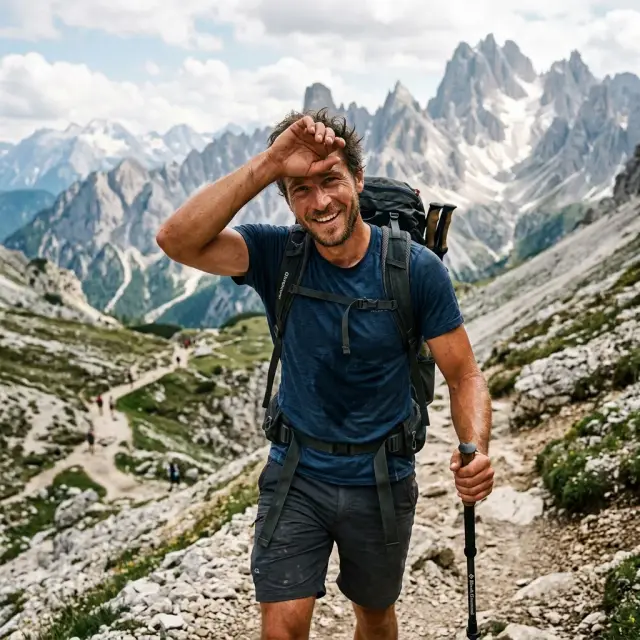
Image: a display asset from the RadiantSnaps site, a style example rather than an effect promise; style count is as currently shown on the site.
Privacy deserves its own look for this group. The site says uploaded photos aren't stored or viewed, generated photos are auto-deleted after 30 days, and payments are handled by Stripe. For someone newly back in the market and uneasy about "where do my photos go", that line is worth reading before the style count. Prices below were captured from /pricing on 2026-11-09:
| Tier | Price | Allowance | Validity / note |
|---|---|---|---|
| Free | $0 | 3 AI-generated photos | "No credit card required to start" |
| Standard monthly | $29 / month | 110 / month (100 + 10 bonus) | 31 days |
| Premium monthly (Most Popular) | $39 / month | 210 / month (200 + 10) | 31 days |
| One-time Basic | $20 | 20 photos | 365 days, check the checkout page |
| One-time Standard | $40 | 100 photos | 365 days, check the checkout page |
| One-time Premium | $60 | 200 photos | 365 days, check the checkout page |
The one-time tiers come from the site's page dictionary, so check the checkout page for the current price, photo count and validity. The site's FAQ also says there's no standard refund because AI compute costs are high; for a clear technical fault or artefacts, contact support@radiantsnaps.com for priority support. For a first-timer the sane order is: try the free 3 photos, confirm the results still look like you, and only then decide about paying. The flow is on the /generate page and the full tier list on /pricing.
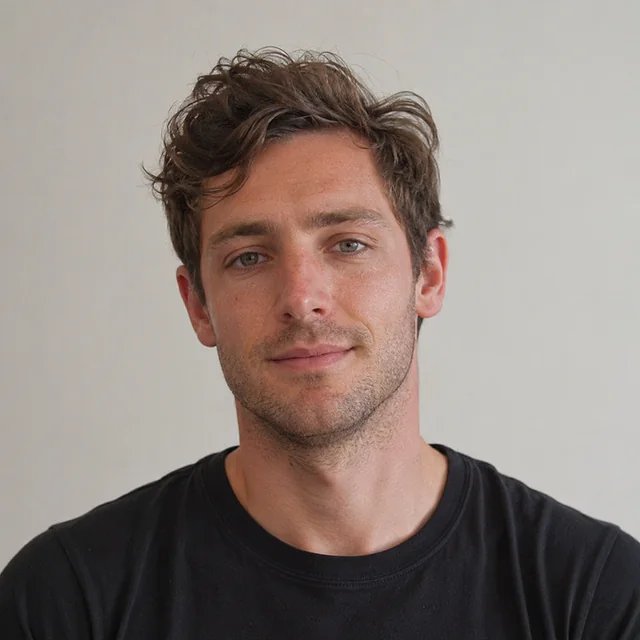
Image: a RadiantSnaps site style example; upload requirements per the site's FAQ, generated images auto-deleted after 30 days.
An honest limit
One point can't be dodged. Hinge's own Gen Z D.A.T.E report found 88% of users uncomfortable with AI-generated profile photos, with the official wording "skip the AI-generated profile photos" (https://hinge.co/newsroom/ai-dating-guide). That doesn't mean "no tools"; it puts the line at "does it still look like you". Better light, framing and background - fine; changing your face or turning up as someone else - not fine. Hinge relationship scientist Logan Ury's line about messages transfers neatly to photos: AI is "great for a gut check or getting unstuck, but the goal isn't a perfect message. It's a message that sounds like you" - a second opinion, not a decision-maker.
So the discipline is: mix results with real snapshots, don't grade the whole set one tone, keep scenes inside your actual life, pass whatever Face Check the platform asks for, and run the three-second recognition test - could someone pick you out in a cafe in three seconds. We won't describe RadiantSnaps as bypassing verification, changing your face or letting you pass as another person; the core claim is only ever "better lighting, framing and background while staying recognisably you". Everything here is per public summaries; check each platform's official terms before publishing.
And keep the marketing out of the evidence pile. The site also says "Get 10x More Likes", "4.2M+ successful matches", "100,000+ users", case figures of "Match Rate 12x / 13x" and "Profile Views 14x", and a Bumble page "94% can't tell AI".
| Site marketing claim (brand's own) | How this article handles it |
|---|---|
| Get 10x More Likes | Website marketing claim, no third-party audit or published methodology; no effect promise |
| 4.2M+ successful matches, 100,000+ users | Same; never placed beside first-party or official figures |
| Bumble landing page "94% can't tell AI" | Same; a brand-page claim of a different calibre from any third-party survey |
| Case figures Match Rate 12x / 13x, Profile Views 14x | Same; treated only as user cases or site wording |
If a thin photo library is the one thing holding you up, the cheapest move is this: pick a recent selfie with good light, face forward, no hat or sunglasses, open the RadiantSnaps site and generate the free 3 photos, keep only the ones that still look like you, and set them alongside a real snapshot to make the four. No card, no upfront payment. If it doesn't suit you, stop there and treat it as a tidy-up of the photo library rather than a bet.
A checklist you can actually follow
- Audit the library and rebuild the four-photo set: clear headshot / full body / real-life scene / hobby. Replace what's missing, don't swap everything at once, and don't grade all four the same.
- Recent photos first: prioritise shots from the last 12 months that show the face you have now. Old group shots and blurred cropped half-faces go in the bin.
- No "ten years younger" retouching: no heavy smoothing, slimming or hair-colour swaps, no backgrounds from places you've never been. Write the goal as one line - they recognise you in three seconds.
- One platform at a time: if you want something steady, don't spend the evening on meme-and-swipe products. Pew shows the age profiles differ sharply, but "have used" isn't "right for you" - adjust to what's actually live near you.
- Switch the safety features on: complete the photo / face verification, keep the chat in-app, report and stop at any request for money, a code, an external link or an investment pitch, and don't give out your address, workplace or finances before meeting.
- First meeting in daylight, in public: coffee, brunch, a market, an exhibition; travel yourself, and tell a friend the time, place and whose profile it is.
- Make the invitation concrete and easy to decline: a specific time, a specific place and room to say no - "Saturday 10am at that cafe, half an hour if you're free, absolutely fine if not" beats "we should meet sometime" by a mile, and it's more dignified.
- Set offline boundaries before you go: don't block a path, don't follow, leave the moment someone says no; treat IRL as an extra road, not an assignment.
- Give messages one short fixed slot each week, then review: don't let the app eat the evening; after two weeks with no real progress, change one photo or one opener rather than increasing spend.
Sources and caveats
Every source used above, tagged so you can check it.
| Source | Type | Used for |
|---|---|---|
| https://www.pewresearch.org/short-reads/2023/02/02/key-findings-about-online-dating-in-the-u-s/ | First-party (research institution, 6,034 US adults, 2023-02-02) | 30%, 10%, 53% / 46%, 35% (41% / 22%), 48% / 49%, 50% vs 11%, 46% / 31% / 28% |
| https://www.pewresearch.org/internet/2023/02/02/the-who-where-and-why-of-online-dating-in-the-u-s/ | First-party (full report) | Sample, method, age splits |
| https://hinge.co/newsroom/ai-dating-guide | Platform's own disclosure | 88%, "skip the AI-generated profile photos", Logan Ury wording |
| subriff.com "top threads this month" snapshot (Sept-Oct batch) | Second-hand (third-party leaderboard, lags ~1 month, no per-thread permalinks) | Community sizes, +6.2% / +4.4%, 9-10 batch heat; not Reddit official statistics |
| old.reddit.com subreddit /top/?t=month (live capture, 2026-11-09) | First-party (live capture, snapshot) | November comment counts; permalinks printed in the forum table |
| https://www.reddit.com/r/technology/comments/1wd8dnz/dating_apps_are_dying/ | First-party (thread plus top comments, 2026-09) | u/Ragegasm and u/stormblaz quotes as sentiment |
| https://www.govinfo.gov/content/pkg/CRPT-119srpt58/html/CRPT-119srpt58.htm | First-party (US Senate Report 119-58, 2025-09-02) | FBI Elder Fraud: 6,700+ victims aged 60+, ~$367M in 2023; FTC 2024 59,000+ / ~$1.2B / $2,000 median; 2023 64,000+ / >$1B |
| https://radiantsnaps.com/ (plus /en, /generate, /pricing) | Brand's own claims (site, captured 2026-11-09) | Positioning, upload requirements, price table, privacy, refunds, styles, photo-set advice, product images |
Caveats: every vote and comment count is a 2026-11-09 snapshot of discussion volume, not incidence; all "N days ago" are relative to that date; the Sept-Oct batch is a third-party snapshot roughly a month behind and isn't combined with the November capture. Quora's Dating Apps topic is thick with promotional and stolen-photo scam accounts, so it's usable only for first-hand phrasing, never as recent sentiment or a factual source. We don't use the widely circulated figures with no traceable original study. Media reporting isn't a regulator's conclusion, and site marketing claims aren't research. That's the whole case for dating over 40: do the side you can actually hold, pick the right room, and keep the first meeting small, public and in daylight.
Frequently Asked Questions
- Is Match really the best dating app over 50, or is that reading too much into Match vs Tinder over 50?
- It's an overreach. Pew's 50% vs 11% compares how many 50+ online daters have ever used each product, so it shows a big difference in reach, not a winner in a Match vs Tinder over 50 head-to-head, and not "the best dating app over 50" for you. The real choice depends on which app still has active local people and what you want - and the 41% payment rate among over-30s says this group will pay for good filtering, not that a dearer tier works better. Use the figure as a hint about the crowd, not a shopping verdict.
- I'm dating after divorce at 50 with no recent solo photos. Where do I even start?
- Start with the four-photo set and nothing else: one clear headshot, one full-body, one real-life scene, one hobby shot, prioritising anything from the last 12 months. It's the rare variable entirely in your control that still decides whether someone opens your profile properly. Old couple shots and cropped half-faces don't belong there. Dating after divorce at 50 also means the rules, tiers and verification have all changed, so use one platform at a time and give it a fortnight before judging. No photo set guarantees a reply or a date, but it stops you losing at the first gate.
- Are the +6.2% and +4.4% community growth figures official Reddit statistics?
- No. Those two rates, and the 15.887M / 4.901M / 5.971M-style community sizes, come from a third-party subriff.com "top threads this month" snapshot roughly corresponding to mid-September to mid-October, lagging about a month, **not Reddit official statistics** and not a live 2026-11-09 reading. We keep them in a separate "third-party snapshot" frame purely to show the difference in relative growth, and never add them to the November comment counts or set them beside Pew's first-party survey. For actual population reach, use Pew.
- When you're dating over 40 and want to meet people offline, is a brunch date really the safest first meeting?
- It's a strong default, not a guarantee. A brunch date is daylight, public, has a natural finishing point, costs what you choose to spend and carries no pressure to drink - which is why it keeps surfacing in r/dating_advice. Travel there yourself, tell a friend the time and place, keep early chat inside the app, and don't hand over your address, workplace or money. Offline swaps catfish photos and bots for in-person safety and manners, so it isn't automatically "safer", just a different set of risks. And it isn't for everyone - shyness, mobility, caring duties or a thin local scene are all good reasons to keep apps as the main channel.
- Will using AI photos to fix a thin photo library count as catfishing?
- The line isn't "did you use a tool", it's "is it still you when you turn up". Better light, framing and background while staying recognisable is tidying a photo; swapping a face, inventing a life or placing yourself somewhere you've never been crosses it. Three workable tests: keep only shots that still look like you, mix them with untouched real snapshots, and run the three-second recognition test. Take Hinge's 88% discomfort with AI-generated headshots seriously too - don't grade the whole set one tone, don't make it all generated, and pass the platform's photo verification. A tool can't certify that line for you; your usage discipline does.