How to Spot Fake Dating Profiles (and Romance Scam Signs) Before You Meet
In 2024, more than 59,000 US consumers reported romance-scam losses to the FTC totalling nearly $1.2 billion, with a median loss of $2,000 per person - and Pew's 2023 survey found adults split almost down the middle on whether online dating is safe, 48% to 49%. This isn't a piece for scare-mongering. It puts the verifiable official figures, real first-hand accounts from Reddit and Quora, the limits of platform verification, and a seven-step check you can run before meeting in one place. It also says plainly the thing most articles dodge: how to spot fake dating profiles is bound up with AI photo tools being a double-edged sword, because the same technology that makes your own profile easier to verify can be used to fabricate a person who doesn't exist, and that is a line nobody should cross.
Cover: a conceptual image, no statistics embedded. Every figure below traces to a government document, a first-party survey, a media report or a live thread capture listed under Sources and caveats.
The short version: how to spot fake dating profiles is a verification problem
- Romance scams are a billion-dollar problem, and the official figure is a floor, not the full picture. Reported losses are only the cases people were willing to file.
- What matters isn't how good the photos look - it's whether the identity can be cross-checked cheaply. A pretty picture is easy; a consistent, verifiable person is hard to fake.
- Two accelerants matter more than any single clue: how early they push to move off the app, and how early the first request for money arrives. The earlier both show up, the higher the risk.
- Face matching and ID checks stop some bulk fake accounts, but not a patient catfish using real or stolen photos. Verification checks a credential, not a story.
- AI photo tools cut both ways. They must never be used to fabricate someone else's identity, steal their photos or invent a "person" who doesn't exist. What they can legitimately do is make your own side stand up to scrutiny.
Romance scam signs start with the numbers: $1.2B, 59,000+ reports, and an undercount
Start with the hardest figures. Everything in this table comes from US Senate Report 119-58 (2025-09-02), which cites FTC Consumer Sentinel data and the FBI Elder Fraud Report, plus one Pew measure for context.
| Figure | What it means | Source |
|---|---|---|
| 2024: 59,000+ consumers reported, nearly $1.2B lost, median $2,000 | One year of romance-scam reports to the FTC; the median shows this is high-volume, small-ticket, not just one big fish | US Senate Report 119-58, citing FTC Consumer Sentinel |
| 2023: 64,000+ people, losses over $1B | Roughly double the ~$500M of four years earlier | Same |
| 2023: 6,700+ victims aged 60+, close to $367M lost | A separate older-victim count: fewer people, but a much higher loss per head | Same, citing FBI Elder Fraud Report |
| 48% / 49% | US adults who think online dating is safe / unsafe - essentially a coin flip | Pew Research Center, 2023-02-02, 6,034 US adults |
Source: https://www.govinfo.gov/content/pkg/CRPT-119srpt58/html/CRPT-119srpt58.htm and https://www.pewresearch.org/short-reads/2023/02/02/key-findings-about-online-dating-in-the-u-s/ .
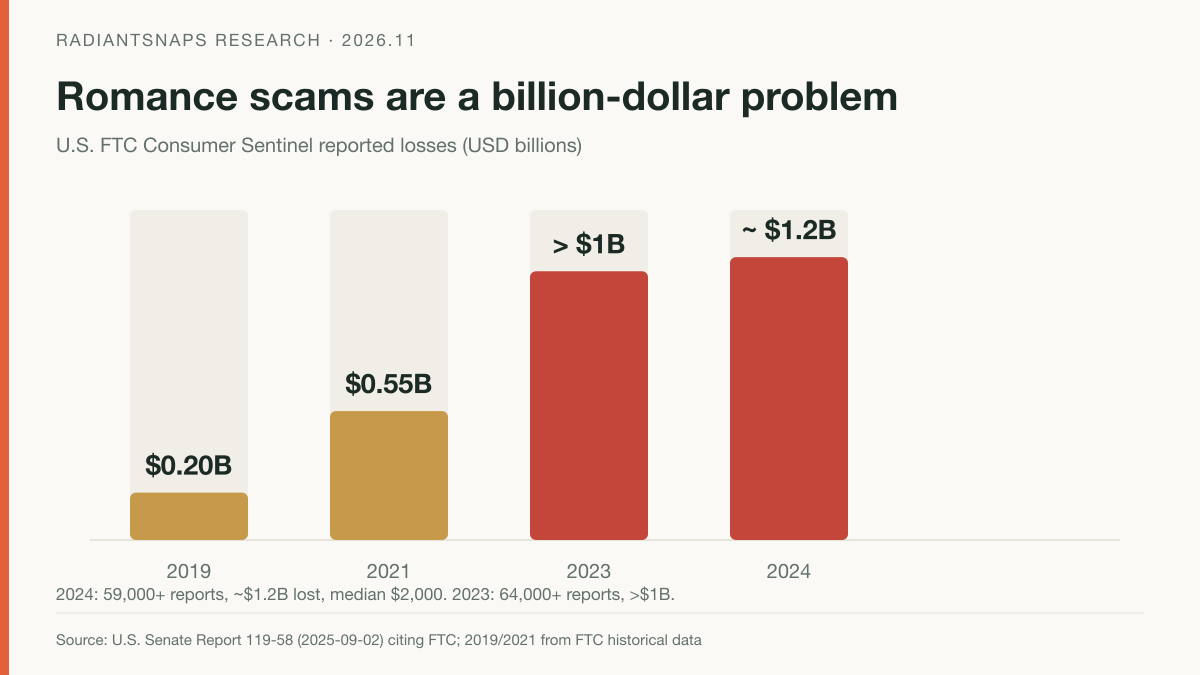
Chart source: US Senate Report 119-58 (2025-09-02) citing FTC Consumer Sentinel; the 2019 and 2021 bars are FTC historical compilations. The source is noted at the chart's foot.
The trend line says more than any single number: from about $200M in 2019 to ~$550M in 2021, past $1B in 2023 and ~$1.2B in 2024 - a roughly sixfold rise in reported losses across four years. One qualification has to be written down: FTC figures are reported losses, and the real total is higher. Romance scams carry a heavy dose of shame and self-blame; plenty of victims never report, never tell family, and sometimes keep talking to the person even after being warned. What reaches the statistics is only the share willing to speak up.
The $2,000 median deserves its own read. It means the mainstream method isn't draining one person dry in a single hit - it's a lot of small, repeatable reasons to pay, where the second request is usually harder to refuse than the first. And Pew's 48% / 49% says something else: there isn't even social agreement on whether online dating is safe, so trusting a gut feeling is a poor strategy. A short sequence of checks beats a vibe every time.
12 red flags, and the low-cost way to check each one
A single flag proves nothing - anyone can be travelling, have a bad connection or simply dislike video calls. The signal is several showing up together, and a consistent pattern of dodging the moment you try to verify. Each row below gives the "why it's a flag" and a cheap, non-confrontational way to test it. These are the romance scam signs worth actually acting on.
| # | Red flag | Why it's a flag | How to verify |
|---|---|---|---|
| 1 | A job that explains being permanently elsewhere: military, offshore work, overseas contract, international organisation | "Not local" is the master excuse for every future "can't meet", and the uniform carries borrowed trust that's hard to check | Ask the specific posting, shift pattern and leave rota; rephrase it a few days later and see whether it matches |
| 2 | Intense feelings, talk of the future and "meant to be" within days | Fast escalation builds emotional leverage before you've had time to check anything, so later refusals feel like hurting someone | Slow it down deliberately - "I'd like to take this slowly" - and watch whether they respect it or push |
| 3 | Keen to move to WhatsApp, Telegram or another off-app tool | Leaving the platform drops the message log, reporting and fraud controls, and makes it easy to run many accounts at once | Stay in the app; treat "why not chat there instead" as a question that needs an answer |
| 4 | An endless supply of reasons not to meet or video: travel, illness, broken kit, time zones | Not meeting is the physical precondition of the whole scheme; the reason rotates, the conclusion never changes | Offer one concrete, generous window and see whether they lock it in or defer again |
| 5 | Photos that are too perfect, and all in the same style, light and colour grade | Likely one stock set, a model's gallery or a single generation batch - absent the mess of a real life | Run each image through reverse image search; compare backgrounds, seasons and haircuts for one continuous life |
| 6 | Reverse image search finds the same face or the same photo elsewhere | Direct evidence the pictures were reused - one of the hardest proofs of a stolen-photo profile | Search on more than one engine and watch for horizontally mirrored copies |
| 7 | Specific details come back vague, or change between tellings | An invented identity has no real memory behind it, only vague filler and on-the-spot patches | Note down three details and cross-check them a week later with a differently worded question |
| 8 | A sudden family illness, accident, customs hold or fine | Manufactures time pressure so you pay before you've had a chance to think | Stop, don't pay, and offer to confirm it independently through another channel - watch for sudden anger |
| 9 | Steering toward crypto, gift cards, wire transfers or "pay on my behalf" | Hard to reverse, hard to freeze - the standard cash-out route | Treat it as a termination signal, not a "method" to be negotiated |
| 10 | Refusing a live video call, or a call with odd lighting, lip-sync drift, or a pre-recorded feel | A real call would collapse most of the risk; a fake FaceTime video scam relies on screen recordings, face swaps or someone else's footage | Ask them to do something spontaneous on the spot, turn the camera, or say the current time or weather |
| 11 | The photos disagree with each other on light, season, haircut and apparent age | They weren't taken in one period by one person - they were assembled | Line them up side by side: winter coat against a summer beach, hair length jumping back and forth |
| 12 | Nothing in the profile's identity can be confirmed against any public detail | Real people leave small, incidental traces that check out | Ask three small cross-checkable details rather than "are you a scammer" |
The six stages of a romance scam, in order
Put those flags on a timeline and you get a fairly stable sequence. Not every case follows all six exactly, but it's a solid frame for spotting where you are.
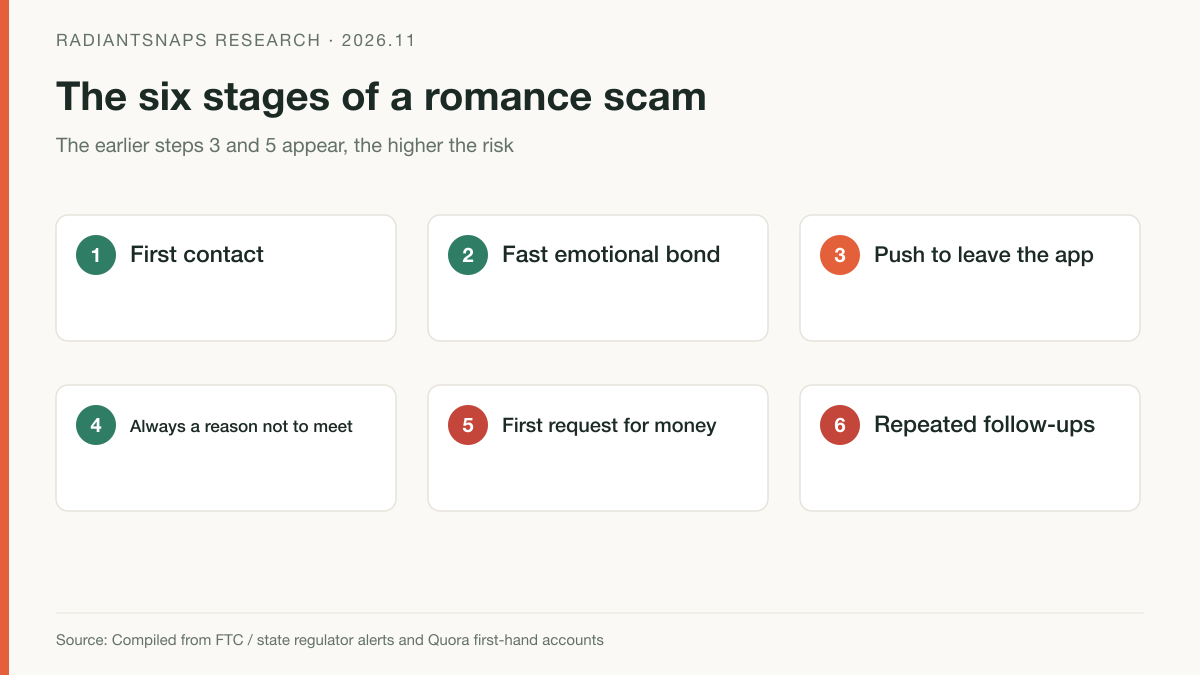
Flow chart compiled from public FTC and state financial-regulator scam guidance plus Quora first-hand accounts; a recognition frame only, not a claim that every case follows this exact order.
| Stage | What happens | What it's for |
|---|---|---|
| 1. First contact | A good photo and a decent opener, usually inside the app - indistinguishable from a normal match | Get in the door |
| 2. Fast intimacy | High-frequency chat, heavy compliments, talk of a relationship and a shared future early on | Make it emotionally costly to walk away later |
| 3. Move off-platform | "I'm hardly on here", "this app is awkward" - shift to a private messenger | Leave the log, reporting and fraud controls behind |
| 4. Never quite meeting | Travel, postings, illness, broken equipment take turns; the answer is always no in-person or live video | Preserve the physical gap the whole scheme needs |
| 5. The first ask for money | Usually a modest sum with an urgent, concrete reason | Test willingness to pay, not the amount |
| 6. Repeat requests | Fees, taxes, "unfreezing" charges, return flights pile up | Keep extracting until the victim wakes up or runs dry |
The earlier stages 3 and 5 appear, the higher the risk. Moving off-platform is about escaping the paper trail; the first money request is where the cashing-out starts. A normal acquaintance essentially never completes both "switch apps" and "can you lend me money" within a few days, so if those two show up early you don't need to wait for more evidence - stop.
What the forums are actually saying: Quora first-hand accounts and Reddit bots
All times, votes and comment counts below are 2026-11-09 snapshot values of discussion volume, not incidence - how many people wanted to type about something, not how often it happens. They're for pinning down exact phrasing, never for statistics.
Quora's first-hand material
The Quora Dating Apps topic has roughly 5K followers and is sorted by "recently updated", which mostly means new answers to old questions rather than new topics. The entries most relevant here:
| Updated | Question | Answerer |
|---|---|---|
| Oct 28 | Can romance scams use fake videos on FaceTime? | Pamela (author of The Love Fraud Chronicles) |
| Aug 8 | What are common turn-offs that you see on men's dating app profiles? | Lisa Newall |
| Jun 11 | Why do dating apps struggle with catfishing despite ID checks, photos, and profile verification? | OpenBlueprint |
| Mar 19 | Why is modern dating so hard even when we have more options than ever? | Franklin Veaux |
The evergreen questions are better for the words people actually use. "Are dating apps full of scammers and fake people?" has 63 related answers covering paywalled fake messages, being charged after cancelling, and stolen military identities; "How can I identify fake profiles in dating apps?" is a long first-hand account full of reverse image search, mirrored flips, gift and crypto scams, and an allegation that "companies reuse old profiles". Those two are the main source of phrasing for the red-flag table above.
One warning has to be blunt: Quora's Dating Apps topic is dense with promotional spam accounts, funnel links and stolen-photo romance-scam profiles - including a known network that lifts model photos, posts short high-frequency answers and hangs redirect links off them. So Quora here is usable only for first-hand phrasing and personal narratives, never as recent sentiment, and never as a factual or statistical source. What we take from it is "how a person describes their own experience", not "how many people this happened to".
Bots and fake matches in Reddit's own words
Reddit gives the other kind of material: checkable dates, votes, comment counts and unvarnished quotes.
| Thread | Subreddit | Timing / heat | Link |
|---|---|---|---|
| Several years of no matches/fake matches across every dating app I've tried | r/OnlineDating | 18 days ago / 39 comments | https://www.reddit.com/r/OnlineDating/comments/1xc51xy/several_years_of_no_matchesfake_matches_across/ |
| Dating Apps Are Dying | r/technology | around 2026-09, long thread | https://www.reddit.com/r/technology/comments/1wd8dnz/dating_apps_are_dying/ |
| Scams are us...I got robbed version :) | r/datingoverfifty | 9-10 third-party snapshot, 540 / 119 | https://www.reddit.com/r/datingoverfifty/ (community entry; snapshot gave no permalink) |
The r/OnlineDating post puts "fake matches" and "years of no matches" side by side, which is exactly the drain of bot profiles: you can't tell whether there's a person on the other end who'll ever answer. In "Dating Apps Are Dying", u/stormblaz's top comment named the mechanics:
"They started locking good candidates behind paywall, ads every 3 swipes that open up a intrusive link, and on top allow bots to post onlyfan profiles looking to endorse their content behind a dating profile."
Paywalls, an ad every few swipes and OnlyFans funnel bots dressed as ordinary profiles, stacked together. Those accounts may not take your money directly, but they eat attention and make "attractive photo" itself less trustworthy.
"Scams are us...I got robbed version :)" (540 / 119) is a first-hand loss post; the same third-party snapshot also has "Newly divorced at 60—is this a scam or a genuine coffee date? Need advice." (274 / 435). Both point the same way as the Senate report's finding that older victims lose more per head. To be precise: those two come from a subriff 9-10 batch leaderboard snapshot, the source list supplied no permalink, so we give the verifiable community entry https://www.reddit.com/r/datingoverfifty/ and don't fabricate a thread URL. In short, Reddit supplies heat and wording, Quora supplies first-hand narrative - neither is a statistical sample.
FTC romance scam losses and the other numbers you can verify
The same number carries a different weight depending on its status. Pew Research Center's 2023-02-02 survey of 6,034 US adults is the one research-institution source here you can quote as fact:
| Pew 2023 measure | Figure |
|---|---|
| US adults who've used a dating site or app | 30% (53% of under-30s) |
| Positive / negative experience among users | 53% / 46% |
| Think online dating safe / unsafe | 48% / 49% |
| Ever paid for a dating platform | 35% |
| Online daters 50+ who've used Match / Tinder | 50% vs 11% |
Source: https://www.pewresearch.org/short-reads/2023/02/02/key-findings-about-online-dating-in-the-u-s/ and https://www.pewresearch.org/internet/2023/02/02/the-who-where-and-why-of-online-dating-in-the-u-s/ .
Everything else gets sorted into a different bucket, and here's the rule we apply:
| Status | Example | How this article handles it |
|---|---|---|
| Government document / official statistic | Senate Report 119-58 citing FTC and FBI; the Pew survey | Usable as fact, with source and year tagged on every figure |
| Media reporting (second-hand) | Reporting on Senate investigation documents; reports of users complaining to the FTC | Always "per media reporting", never a regulator's conclusion, not used as a verdict |
| Forum first-hand accounts | Reddit threads, Quora answers | Wording and heat only - never a statistic, never sentiment data |
| Brand's own claims | Effect-type claims on a product site | Labelled separately as "site says", never placed beside official figures |
One more credibility note. Claims like "1.9 seconds per profile", "52% of swipes decided by the first photo", "34.2% match rate", "272% more matches", "21x date rate", "90% of first impressions come from the photo", "1.8M profiles analysed", "78% or 79% user burnout", "89% photo mismatch" and "AI photos 32.8% match rate" bounce endlessly between AI-dating-photo SEO pages with no original dataset and no published methodology. We don't use them, we don't put them in any table, and we don't lean on them as evidence. Keeping untraceable numbers out is itself part of being credible.
What catfish verification does and doesn't catch
The following is a public summary; check each platform's official terms before you publish anything. Verification names, coverage and whether they're mandatory all shift by market and over time.
| Platform | Mechanism | Roughly what it does | What it still misses |
|---|---|---|---|
| Tinder | Face Check (video selfie face match) | Confirms the person running the account matches the profile photo | Accounts opened with someone's real or fully stolen photos, account handovers, live face swaps |
| Hinge | Face Check | Same video-selfie-to-photo comparison | Same; also doesn't check job, history or marital status |
| Bumble | Deception Detector | Flags suspicious profiles and bulk fraud patterns | Slow, human-operated, long-run catfishing |
| ID verification (various) | Document plus selfie comparison | Proves "this document exists" and "this one time it's this person" | Borrowed or stolen IDs, someone else chatting after verification, a story that's simply invented |
Why does catfish verification still let scammers through? Because it checks whether a one-off credential matches a biometric, not whether the story is true. Catfishing is about lying, not face swapping: a real, fully documented person can steal someone else's photos, invent a career and a romantic history, pass the check, and then have a different person do the chatting. Face matching lowers the efficiency of bulk fake accounts; it never reaches the "identity narrative" layer. That's exactly why this article puts cross-checking on the person rather than on the badge.
Some background belongs here, with its status nailed down: per media reporting on Senate investigation documents, a 2026 bipartisan Senate investigation obtained roughly 670 pages of Match Group internal files; the reporting says scam-profile views grew 700%+ between May 2024 and December 2025, that of about 1.5 million fraudulent accounts in the first three quarters of 2025 nearly 500,000 exchanged contact details with matched users, and that Tinder subsequently rolled out mandatory Face Check. These are second-hand media accounts of Senate investigation documents - not a regulator's conclusion, and not verified by a regulator as a finding. The specific figures should be checked against the Senate investigation documents and official records; we cite them only to show that platforms themselves keep adding verification, and we do not place them in the government-document data table above or treat them as a regulatory determination.
What you control and what you don't
Scams feel paralysing because most of the variables sit on someone else's side of the table. Moving your attention to the left-hand column is the most practical step in this whole method.
| What you control | What you don't |
|---|---|
| Whether your own photos are recent, real and recognisable | Whether the other person is who they claim |
| Whether you stay in-app and keep the chat log | The platform's algorithm and the total number of fraud accounts |
| Whether you run a reverse image search and ask for one live video | Whether they agree to be checked |
| Whether you send money (the answer is always no) | Whether money already sent can be recovered |
| The time, place and friend you tell about a first meeting | Their actual intentions |
The five items on the left need no tool and no special access - anyone can do them today. The five on the right won't budge however much you worry at them. That's the whole point: learning how to spot fake dating profiles isn't about becoming a detective, it's about making your own side solid enough that there's no opening to exploit.
AI photo tools are a double-edged sword: the line you must not cross
This article has to be the most honest one in the series, because we build an AI photo tool ourselves.
Uses that are off-limits, full stop
AI photo generation is a double-edged sword, and it must never be used to fabricate someone else's identity, steal their photos or invent a "person" who does not exist. Dropping another face into a new scene, tidying up a model's image and passing it off as you, generating a face that belongs to nobody to register a profile, or using a face swap to get through a live check - all of it sits on the wrong side of that line. It isn't just a platform rule breach; it can be fraud. More directly, it's precisely what the victims in the first half of this article ran into. The easier the tools get, the more clearly that boundary needs stating rather than blurring.
Making your own profile stand up to a check
Turned on yourself, the same kind of tool should aim at "more verifiable", not "more like someone else":
- Use recent photos, not a version of you from three or five years ago.
- Keep scenes real - no places you've never been, gear you don't own, hobbies you don't actually do.
- Mix with untouched real snapshots; don't make the whole set one generation batch.
- Be recognisable on video and in person - the three-second recognition test: someone can pick you out outside a cafe in three seconds.
- Don't grade the whole set to one tone, one light, one style; that's the single most obvious tell of a fake profile.
- Pass the platform's Face Check honestly, and don't go looking for a way round it.
In one line: making a photo better is fine; making "you" unrecognisable isn't.
About RadiantSnaps: not an anti-fraud tool
If "make my own side verifiable" is the part you want to tidy up, RadiantSnaps is where to start. Its own positioning line is "Turn casual selfies into standout dating profile pictures - without the AI look.", and "without the AI look" plus "staying recognisably you" land exactly on this article's point: it works on light, composition and background, turning a throwaway selfie into a decent profile shot while the person in it is still you. It isn't a face-swap tool, doesn't bypass platform verification and doesn't turn you into somebody else.
The upload requirements make that plain. The site's FAQ asks for your own selfie: good light, face forward, neutral or slight smile, no sunglasses, no hat, nobody else in frame; generation only adjusts light, background and framing. The input has to be the real you before "verifiable" means anything. The flow is on the /generate page and the tiers on /pricing.
| Tier | Price | Allowance / validity |
|---|---|---|
| Free | $0 | 3 generated photos, no credit card required to start |
| Standard monthly | $29 / month | 110 / month (100 + 10 bonus), 31 days |
| Premium monthly (Most Popular) | $39 / month | 210 / month (200 + 10), 31 days |
| One-time Basic | $20 | 20 photos, 365 days, check the checkout page |
| One-time Standard | $40 | 100 photos, 365 days, check the checkout page |
| One-time Premium | $60 | 200 photos, 365 days, check the checkout page |
| Item | What the site says |
|---|---|
| Uploads and privacy | Uploaded photos aren't stored or viewed; generated photos auto-deleted after 30 days; payments handled by Stripe |
| Refunds | No standard refund because AI compute costs are high; for a clear technical fault or artefacts, contact support@radiantsnaps.com for priority support |
| Styles | The site says both "25 photo styles" and "26 premium photo vibes", so read it as about 25-26, as currently shown on the site |
| Flow | Upload a clear selfie, pick a style, photos ready in minutes (the Bumble landing page says 5 min) |
| Upload requirements | Good light, face forward, neutral or slight smile, no sunglasses, no hat, no one else in frame |
| Photo-set advice | One clear headshot + one full-body + one social / life + one hobby / personality, and "only keep photos that still look like you" |
The one-time tiers come from the site's page dictionary, so check the checkout page for the current price, photo count and validity. Prices, privacy and policy details above were captured from the site on 2026-11-09.
The site's effect claims need fencing off too. "Get 10x More Likes", "4.2M+ successful matches", "100,000+ users", case figures "Match Rate 12x / 13x" and "Profile Views 14x", and a Bumble page "94% can't tell AI" are website marketing claims with no third-party audit or published methodology. They don't sit in a table with the Pew, Hinge, FTC or filing figures above, and they aren't an effect promise.
| Site marketing claim (brand's own) | How this article handles it |
|---|---|
| Get 10x More Likes | Website marketing claim, no third-party audit; no effect promise, not used in any conclusion |
| 4.2M+ successful matches, 100,000+ users | Same; never placed beside official figures |
| Bumble landing page "94% can't tell AI" | Same; a brand-page claim of a different calibre from any third-party survey |
| Case figures Match Rate 12x / 13x, Profile Views 14x | Same; treated only as user cases or site wording |
Now the boundary, stated all the way down: RadiantSnaps is not an anti-fraud tool and does not verify other people. It doesn't reverse-search images, doesn't check anyone's identity and doesn't decide whether an account is a bot; the verification steps earlier in this article are still yours to run. The only thing it can improve is whether your own profile photos are clear, decent and still you - which affects the first impression of being opened properly, and does nothing for reply speed, the algorithm or someone else's intentions. If you want to tidy your own side, start with the free tier at RadiantSnaps: pick a well-lit, face-forward selfie with no hat or sunglasses, keep only the results that still look like you, and mix them with real snapshots. More at https://radiantsnaps.com/ . That done, at least your side holds up to a check.
A seven-step checklist before you meet
Run these seven before any first meeting - no extra tools, and no need for the other person to cooperate fully. How they respond to each step is itself the answer.
- Reverse image search every photo separately, on more than one engine, watching for horizontally mirrored versions; note any hit elsewhere.
- Ask for one live video call - not a recording, not a heavy filter. Have them do something spontaneous, turn the camera, say the current time or weather; watch lip-sync and light.
- Check the photos against each other: line them up for light, season, haircut and apparent age; flag a winter coat beside a summer beach or hair length jumping around.
- Ask three small cross-checkable details - their neighbourhood, commute, work routine - then rephrase a few days later and see if it still lines up.
- Stay on the platform: keep the chat in-app where there's a log, reporting and fraud control; be wary of "let's talk somewhere else".
- Never send money: crypto, gift cards, wire transfers, customs fees, emergency medical bills, flights - no, in any amount, however small.
- First meeting in daylight, in public, with a friend told: get yourself there and back, share the place and expected finish time, and don't lend money or accept a parcel on anyone's behalf.
If they consistently dodge, rush you or flip it round into "don't you trust me?", take that as the answer, not as a misunderstanding to explain again.
Sources and caveats
Every URL cited or referenced above, tagged by status.
| Source | URL | Status | Used for |
|---|---|---|---|
| US Senate Report 119-58 (2025-09-02) | https://www.govinfo.gov/content/pkg/CRPT-119srpt58/html/CRPT-119srpt58.htm | Government document | 2024: 59,000+ / ~$1.2B / $2,000 median; 2023: 64,000+ / >$1B; FBI Elder Fraud 6,700+ aged 60+ / ~$367M. FTC figures are reported losses; the real total is higher |
| Pew Research Center, 2023-02-02, key findings | https://www.pewresearch.org/short-reads/2023/02/02/key-findings-about-online-dating-in-the-u-s/ | First-party research | 48% / 49%, 30%, 53% / 46%, 35%, 50% vs 11% |
| Pew Research Center, full report | https://www.pewresearch.org/internet/2023/02/02/the-who-where-and-why-of-online-dating-in-the-u-s/ | First-party research | 6,034 US adults, method |
| Reporting on Senate investigation documents | No direct link in the fact pack; check the Senate investigation documents and official records | Media reporting (second-hand) | 670 pages, 700%+, ~1.5M / ~500K; per media reporting on Senate investigation documents, not a regulator's conclusion |
| Straight Arrow News, users complain to the FTC about Hinge / Match Group | https://san.com/cc/they-want-money-pure-and-simple-singles-push-regulators-to-crack-down-on-dating-app-algorithms | Media reporting (second-hand) | The report quotes an FTC lawyer saying such complaints may not be FTC-verified |
| Reddit r/OnlineDating, fake-matches account | https://www.reddit.com/r/OnlineDating/comments/1xc51xy/several_years_of_no_matchesfake_matches_across/ | Forum first-hand | 18 days ago / 39 comments, 2026-11-09 snapshot value |
| Reddit r/technology, "Dating Apps Are Dying" | https://www.reddit.com/r/technology/comments/1wd8dnz/dating_apps_are_dying/ | Forum first-hand | u/stormblaz quote; around 2026-09 |
| Reddit r/datingoverfifty (community entry) | https://www.reddit.com/r/datingoverfifty/ | Forum first-hand / third-party snapshot | 540 / 119 from the subriff 9-10 batch; no permalink supplied |
| Quora Dating Apps topic | https://www.quora.com/topic/Dating-Apps | Forum first-hand | Recent-update entries and evergreen questions |
| Quora: Are dating apps full of scammers and fake people? | https://www.quora.com/Are-dating-apps-full-of-scammers-and-fake-people | Forum first-hand | 63 related answers |
| Quora: How can I identify fake profiles in dating apps? | https://www.quora.com/How-can-I-identify-fake-profiles-in-dating-apps | Forum first-hand | Long first-hand account, source of red-flag phrasing |
| RadiantSnaps site | https://radiantsnaps.com/ | Brand's own claims | Positioning, prices, privacy, upload requirements, photo-set advice, captured 2026-11-09 |
Caveats, once more, because they're where this kind of article most often goes wrong: Quora's Dating Apps topic is dense with promotional spam accounts and stolen-photo romance-scam profiles, so it's usable only for first-hand phrasing, never as recent sentiment or a factual source; Reddit votes and comment counts are 2026-11-09 snapshot values of discussion volume, not incidence; media reporting is not a regulator's conclusion; and the FTC figures in a government document are still only the lower bound of reported losses. None of the widely circulated, untraceable "matches" figures is used here. That, in the end, is how to spot fake dating profiles: not by turning into a detective, but by making your own side unshakeable and letting their answer to each check do the talking.
Frequently Asked Questions
- Does reverse image search dating prove a profile is real if it turns up nothing?
- No. No match only means those images aren't publicly indexed - they may be newly generated, cropped, mirrored, or pulled from a private source that crawlers can't reach. Reverse image search dating is a "hit means high risk" tool, not a "no hit means safe" certificate; pair it with a live video call and cross-checked details. Treat it as one of several checks, never the verdict.
- Can a fake FaceTime video scam get past a live call?
- Willingness to video is a clear plus, but not the finish line. Watch for a pre-recorded feel, lip-sync drift, odd lighting or a frozen background, and ask them to do something unrehearsed, turn the camera or state the current time or weather. A fake FaceTime video scam relies on screen recordings, face swaps or someone else's footage. More importantly, video proves "this face exists and moves"; it proves nothing about whether the job, the history or the reason they need money is real.
- Why does catfish verification like Face Check still let scammers through?
- Because it checks whether a one-off credential and a biometric match, not whether the story is true. A real person with real ID can steal someone else's photos, invent a career and a relationship history, pass the check, and then let someone else do the chatting. Catfish verification lowers the efficiency of bulk fake accounts but never reaches the "identity narrative" layer - so the cross-checking still has to happen on the person, not on the badge.
- Are FTC romance scam losses of $1.2B the real total?
- No - it's the floor. The ~$1.2B for 2024 is reported losses from 59,000+ consumers, with a $2,000 median; 2023 was 64,000+ people and over $1B, and the FBI's Elder Fraud count for 2023 was 6,700+ victims aged 60+ losing close to $367M. Romance scams carry shame and self-blame, so many victims never report or tell family, and some keep in contact even after a warning. The real total is higher than anything in the official table.
- How to spot fake dating profiles when the photos look completely normal?
- Stop judging the photos and start judging the sequence. Run the seven checks: reverse image search each photo, ask for one live call, line the photos up for consistency, cross-check three small details, stay in-app, never send money, and keep the first meeting public and in daylight. A cluster of red flags - an off-platform push plus an early money ask, or a string of reasons not to meet - matters far more than any single picture. Normal-looking photos are exactly the point of a well-run fake profile.
- Is RadiantSnaps an anti-fraud tool that checks other people's profiles?
- No. RadiantSnaps is not an anti-fraud tool and does not verify other people. It doesn't reverse-search images, check identities or judge whether an account is a bot - those steps are yours. It works only on your own photos: better light, framing and background while staying recognisably you. It can't be used to bypass a platform's verification, change your face or pretend to be someone else, and it must never be used to fabricate another person's identity, steal their photos or invent a person who doesn't exist.