Are AI dating photos okay? Where users actually draw the line
Are AI dating photos okay? It's the question Hinge's own Gen Z D.A.T.E. report forces every AI-photo tool to answer, and the number is not friendly: 88% of users said they're uncomfortable with AI-generated profile photos, and the official guidance literally says skip the AI-generated profile photos. RadiantSnaps is an AI photo tool, so we're not going to dodge that. What people actually object to is being replaced by someone else, which is a very different thing from fixing the light, the background and the framing. We call that line identity replacement vs presentation enhancement, and this piece uses Hinge's four figures, Logan Ury's own words, what Bumble and Tinder shipped in 2026, and live Reddit threads from 2026-11-09 to mark it - then gives you six rules you can follow today.
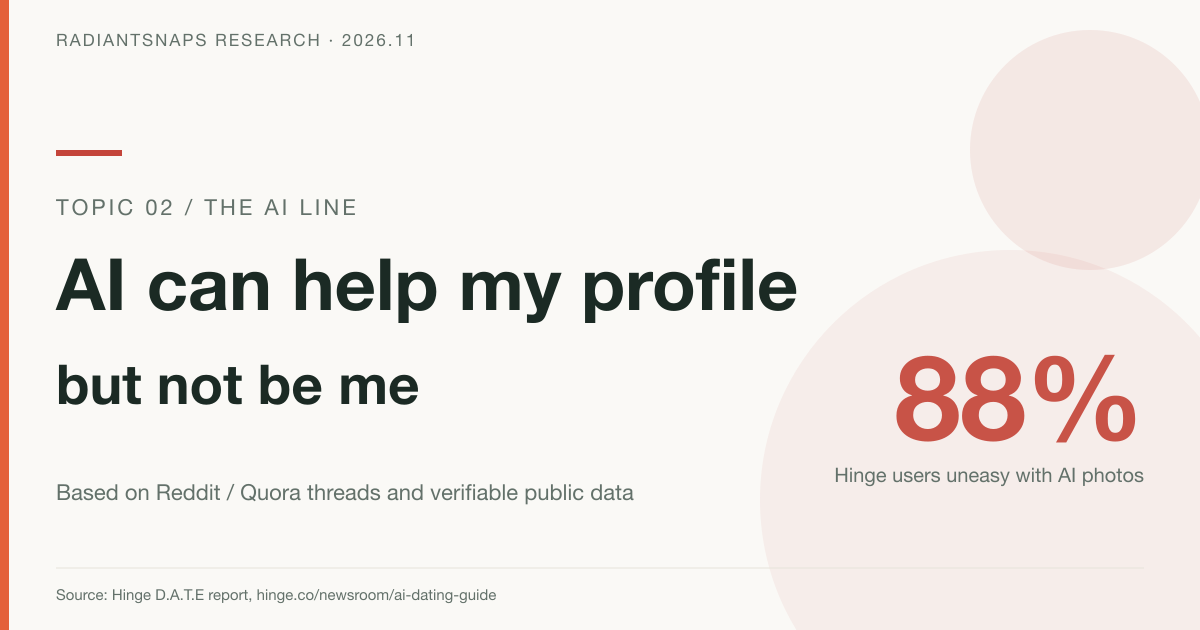
Cover designed by RadiantSnaps Research, 2026.11. The 88% is a "felt uncomfortable" share from Hinge's official Gen Z D.A.T.E report (hinge.co/newsroom/ai-dating-guide), not an adoption rate.
The short version: "are AI dating photos okay" depends on what you're replacing
- The line users draw is very specific: you can help me make my profile better, you can't judge for me, chat for me or show up as me. Hinge's 88% backlash is about "AI-generated headshots" - the person in the photo isn't me - not about "this photo is a bit brighter and cleaner".
- We name that line identity replacement vs presentation enhancement. Adjusting light, framing and background is the latter; swapping a face, inventing a life you never lived, or letting AI write a whole conversation is the former. The former crosses it; the latter is where a tool belongs.
- The line can't be self-certified by a tool. No AI photo tool can guarantee, at the moment it spits out an image, "this is still you". It can only be held up by discipline: upload requirements, screening the results, mixing in real snapshots, human verification and the three-second recognition test. We'd rather put that up front than bury it in a disclaimer.
- Hinge's four figures (88% / 69% / 63% / 52%) measure different things and can't be subtracted. They support one qualitative point only: the closer AI gets to standing in for you, the stronger the pushback; the closer it stays to helping you express yourself, the more room users leave.
- RadiantSnaps sits firmly on the presentation-enhancement side. It affects first impressions and the odds of being opened properly; it does not fix reply speed, algorithmic distribution or someone else's interest, and it promises no multiples.
Are AI dating photos okay on Hinge? Read the 88% figure properly
Here's the chart. It puts the four most-quoted numbers from Hinge's official Gen Z D.A.T.E report in one bar chart, under the title "users draw a clear red line on AI".
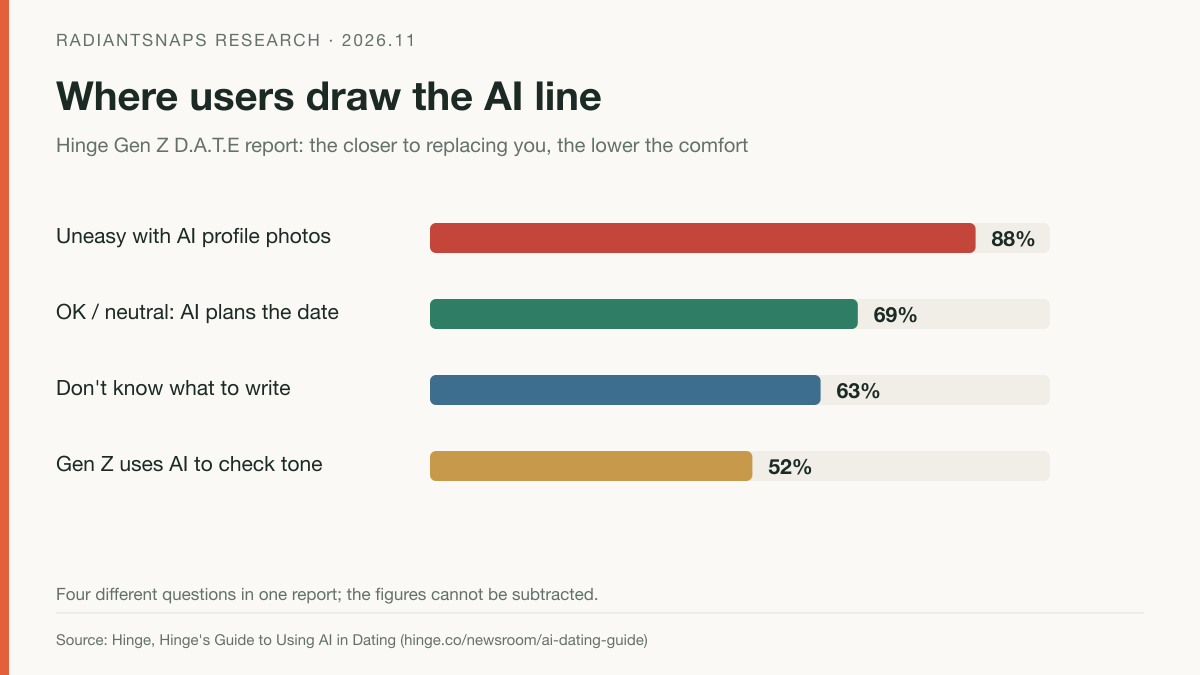
All four bars come from Hinge's official Gen Z D.A.T.E report (hinge.co/newsroom/ai-dating-guide); the chart notes the source at its foot. The four questions are different, so the figures cannot be subtracted from one another.
The AI-comfort ladder, ordered by how close AI gets to standing in for you - not a numeric scale you can do arithmetic on:
| Rung | AI use | Hinge figure | What the figure actually asks | Caveat |
|---|---|---|---|---|
| 1. Stands in for you, most rejected | AI-generated profile headshot, a face that isn't yours | 88% | Hinge users uncomfortable with "AI-generated profile photos" - a negative "uneasy" share | Official wording: skip the AI-generated profile photos |
| 2. Makes your arrangements | AI helps plan the date | 69% | Comfortable or neutral about "AI planning the date" - a positive share | Opposite direction and different wording from 88% |
| 3. Gets you started | You don't know what to write; AI suggests phrasing | 63% | The share who say they don't know what to write in a profile | That's a pain point, not an acceptance rate |
| 4. Checks your tone, most tolerated | Gen Z uses AI to vibe-check a message rather than ghostwrite it | 52% | Usage rate among Gen Z users who already use AI | Denominator is existing AI users, and it's "checking", not "writing" |
Say this plainly: all four come from the same Hinge report, but the question wording, denominator and direction differ - 88% is "uncomfortable", 69% is "comfortable or neutral", 63% is "has this difficulty", 52% is "uses it this way". So they cannot be subtracted, and they are not a descending acceptance scale from 88 to 52. The only thing this table supports is a qualitative reading: as AI moves toward standing in for you or deciding for you, resistance rises; as it moves toward helping you express yourself better, users leave more room. Averaging the four into "how much do users accept AI" misreads one report. The chart's footnote says the same. If you got here by searching "Hinge 88% AI photos", the figure is real - a discomfort share from Hinge's own report, not an adoption rate and not a platform ban - and it exists for the same reason "AI photos look fake" is such a common complaint: people can spot an image that was manufactured rather than taken.
One credibility note. You'll also see claims like "a tool analysed millions of profiles", "the first photo decides more than half of swipes", "AI photos multiply your match rate" and "date rate up dozens of times" bouncing between AI-dating-photo SEO pages, with no published methodology or dataset behind them. We don't use them, and we don't put them in any table. Better one less shiny number than a brick in the argument you can't trace to the ground.
What the forums are actually arguing about
In real threads the "line" isn't abstract. It's a very concrete complaint: is the person I'm talking to actually them, is the photo actually them, did AI make a decision for me. The table is a 2026-11-09 snapshot from the live subreddits, so votes and comment counts will move; gender-grievance threads are quoted only as discussion volume, never as fact.
| Thread | Subreddit | Posted | Comments | Link |
|---|---|---|---|---|
| To women: how fast do you reply if you are actually interested? | r/OnlineDating | 2 days ago | 273 | https://www.reddit.com/r/OnlineDating/comments/1xp3qk7/to_women_how_fast_do_you_reply_if_you_are/ |
| Dating apps are completely frying women's brains. (high-heat gender thread, volume only) | r/OnlineDating | 9 days ago | 365 | https://www.reddit.com/r/OnlineDating/comments/1xjp6sp/dating_apps_are_completely_frying_womens_brains/ |
| what in the world am I seeing | r/Bumble | 1 day ago | 269 | https://www.reddit.com/r/Bumble/comments/1xpwy1g/what_in_the_world_am_i_seeing/ |
| I do not miss dating apps whatsoever. | r/Bumble | 6 days ago | 636 | https://www.reddit.com/r/Bumble/comments/1xlvamt/i_do_not_miss_dating_apps_whatsoever/ |
| Several years of no matches/fake matches across every dating app I've tried | r/OnlineDating | 18 days ago | 39 | https://www.reddit.com/r/OnlineDating/comments/1xc51xy/several_years_of_no_matchesfake_matches_across/ |
| I (25f) am completely overwhelmed with guilt and don't know how people use dating apps ethically | r/hingeapp | 25 days ago | 63 | https://www.reddit.com/r/hingeapp/comments/1x60bbq/i_25f_am_completely_overwhelmed_with_guilt_and/ |
| 30F - Genuine Feedback Please :) | r/hingeapp | 17 days ago | 73 | https://www.reddit.com/r/hingeapp/comments/1xck50b/30f_genuine_feedback_please/ |
| Dating Apps Are Dying (background long thread, source of "loot boxing loneliness...") | r/technology | 2026-09 | not recorded | https://www.reddit.com/r/technology/comments/1wd8dnz/dating_apps_are_dying/ |
Put together, these threads are one emotional arc. Profile-review and "help me write this" requests are thriving, which says users are happy to be assisted; posts about "fake matches", "what in the world am I seeing" and feeling guilty after using the apps point to distrust once authenticity breaks. In the r/technology thread, u/Ragegasm summed up the whole mechanism as "loot boxing loneliness through a swiping algorithm" and u/stormblaz named paywalls, an ad every three swipes and funnel bots - none of that is "anti-technology", it's "against someone making my decisions for me without telling me". The community has never objected to the tool; it objects to having its agency taken away. That's the same direction as Hinge's 88%: fix my presentation if you like, don't touch who I am.
The external numbers you can verify, and what they're worth
Laying the categories out lets you check them yourself. Filings are public quarterly data; user complaints are, per the fact pack, always labelled as not verified by a regulator.
| Data point | Meaning | Status | Source |
|---|---|---|---|
| 30% have used, 53% of under-30s | US adults who've used a dating site or app | First-party: Pew 2023-02-02, 6,034 adults | https://www.pewresearch.org/short-reads/2023/02/02/key-findings-about-online-dating-in-the-u-s/ |
| 53% / 46% | Positive / negative experience among users | First-party: same | same |
| 48% / 49% | Think online dating safe / unsafe | First-party: Pew full report | https://www.pewresearch.org/internet/2023/02/02/the-who-where-and-why-of-online-dating-in-the-u-s/ |
| 88% / 69% / 63% / 52% | Four Hinge Gen Z D.A.T.E figures, different questions, can't be subtracted | First-party: platform report | https://hinge.co/newsroom/ai-dating-guide |
| Tinder 2025 Q4 paying users 8.8M, -8% | Includes RPP $17.63 / +5%, full-year direct revenue $1.9B / -4% | Second-hand compilation of public filings | https://finance.biggo.com.tw/quote/MTCH/earnings-call/US_MTCH_2026-02-03 |
| Hinge 2025 Q4 paying users 1.9M, +17% | Full-year direct revenue $691M / +26% | Second-hand compilation of public filings | same |
| Match Group 2025 Q4 total paying users 13.8M, -5% | Group shrinking while Hinge grows | Second-hand compilation | https://catfishfinder.org/dating-app-statistics/ |
| 39% have used AI, Gen Z 66% | Match Group 2026 survey of 3,000 UK singles | Second-hand: Guardian / AOL reporting, no original questionnaire | no verifiable direct link in the fact pack, background only |
| 2024: 59,000+ reported romance-scam losses of nearly $1.2B | Median loss $2,000 | First-party: US Senate Report 119-58 | https://www.govinfo.gov/content/pkg/CRPT-119srpt58/html/CRPT-119srpt58.htm |
| Users complain to the FTC about "algorithmic manipulation, artificial scarcity" | The report quotes an FTC lawyer saying complaints may not be FTC-verified | Second-hand: user complaint, unverified | https://san.com/cc/they-want-money-pure-and-simple-singles-push-regulators-to-crack-down-on-dating-app-algorithms |
Four statuses have to stay separate: public filing figures are a factual base; a platform's own report is an official position, not neutral research; a user complaint is only someone making an allegation, and the reporting itself notes the FTC hasn't verified it; media reporting reconstructs the timeline of industry moves. Blending them into "research shows" is the most common way this kind of article goes wrong. Every conclusion here rests only on the rows you can follow to a specific URL.
Identity replacement vs presentation enhancement: where the line actually sits
Now for the uncomfortable part. Hinge's Gen Z D.A.T.E report says it outright: 88% of users are uncomfortable with AI-generated profile photos, and the advice is skip the AI-generated profile photos. RadiantSnaps is an AI photo tool. If we pretended that advice had nothing to do with us, this article wouldn't be worth writing.
The honest response isn't "users don't really mind" - it's getting the object of the objection right. What people reject is being replaced by someone else, not having the light and framing fixed. A backlit selfie with clutter behind you and half your face in shadow, and the same face in clean light with a straight crop, are the same person. A "headshot" with the features smoothed out, the skin texture swapped and the setting invented is not. The first is presentation enhancement: the information hasn't changed, only the noise has been removed. The second is identity replacement: the information itself was swapped. The AI-generated in Hinge's advice points at the latter - conjuring a "you" who doesn't exist.
Hinge's own relationship scientist Logan Ury puts the nuance better:
"AI is great for a gut check or getting unstuck, but the goal isn't a perfect message. It's a message that sounds like you." - Logan Ury, Hinge relationship scientist
The same official guide frames AI as "second opinion, not decision-maker".
Source: https://hinge.co/newsroom/ai-dating-guide
"It's a message that sounds like you" and "second opinion, not decision-maker" transfer straight onto photos: the goal isn't a "perfect" photo, it's one that still looks like you, just better shot; the tool is a second opinion, not the thing deciding what you look like, where you've been or what you say. 69% comfortable or neutral about AI planning a date, 52% of Gen Z using AI to check a message's tone, and 88% rejecting an AI headshot aren't contradictory - all three measure the same thing: AI can stand behind me, it can't stand in front of me.
And here's the line most brands quietly leave out: the tool can't certify the line. No AI photo tool can guarantee at the moment of output that "this is still you". What a tool can do is state its upload requirements, limit processing to light, background and framing, and put "only keep photos that still look like you" in its own advice. What actually makes the line hold is whether the user screens the results, mixes in real snapshots, and runs human verification and the three-second recognition test. The line is a product of usage discipline, not of a product description. That's exactly why we put 88% at the top of this article instead of hiding it at the bottom - owning that number is closer to the honesty presentation enhancement is supposed to have.
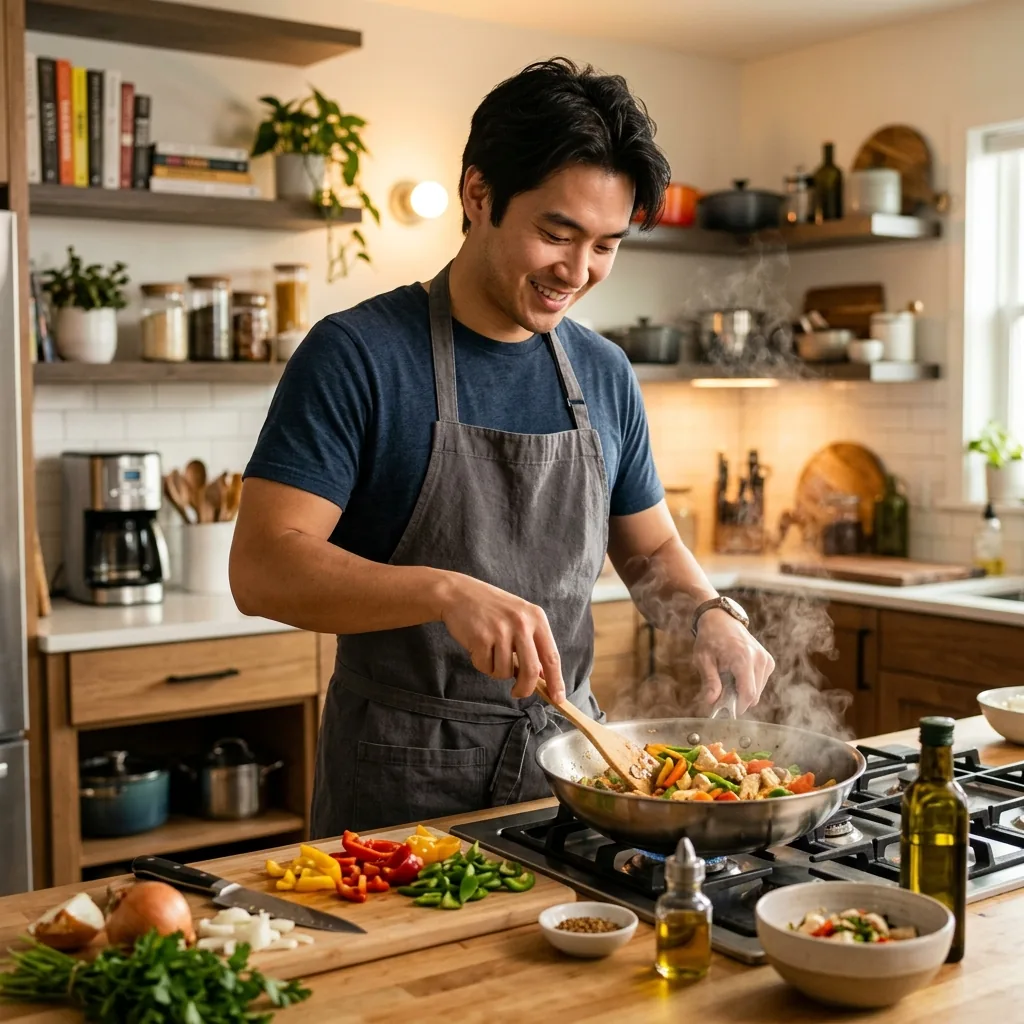
Image: a display asset from the RadiantSnaps site, a brand-supplied example rather than third-party research. It illustrates presentation enhancement changing light, background and framing - not the face, not a fabricated scene.
What the industry shipped in 2026, and the pushback it got
Almost every product move this year prodded the same line. The table maps each one to the specific community pushback and tags the status: filing numbers are public data, community quotes are user claims and unverified.
| Platform / body | Move | Timing and scale | Specific pushback | The line it hits |
|---|---|---|---|---|
| Bumble | Dropped swiping, launched AI assistant Bee, scrapped the "women message first" rule | 2026 Q4 small rollout in a few markets; 2026 Q1 paying users ~3.2M, -21% YoY, which the company calls a deliberate reset | "I lost the right to choose", "why should AI predict who I'm attracted to", "Bumble lost its identity"; CEO Whitney Wolfe Herd later clarified Bee doesn't replace swiping | Can't judge for me |
| Tinder | Chemistry (questions plus optional photo-library scan), Face Check verification | Rolled out through 2026 | The library scan summed up as "Nobody is for it"; broad refusal to let AI pick people | Can't judge for me |
| Hinge | AI Prompt Feedback, Face Check | 2026 | Same "Nobody is for it" territory; 88% uneasy with AI-generated headshots | Can check my wording, can't stand in for me |
| Match Group (UK survey) | 3,000 UK singles: 39% used AI in dating, Gen Z 66% | 2026, Guardian / AOL reporting (second-hand) | "Used" isn't "accepted being replaced"; the people most likely to use AI for a tone check are often the most against AI writing for them | AI is fine, don't cross into ghostwriting |
Read the four rows together and the pattern is stable. Moves that ask AI to decide "who suits me" or "who I should fancy" draw pushback about lost choice; moves that help tidy a profile or check a phrasing get a much calmer reception. One caveat on Bumble's -21%: 3.2M paying users and -21% YoY are public company data, and the company itself explains them as a deliberate reset, not a product failure. Writing that up as "users voted with their feet against AI" welds a filing number to a mood and calls it causation, which we won't do. Likewise, the 39% / 66% in the UK survey means "have used", not "accept", still less "want to be replaced" - someone who uses AI to catch a typo can absolutely be in the 88%.
Does Hinge allow AI photos, and what Bumble and Tinder actually say
This section needs care, because rules change and this isn't legal advice. The table is only a public summary to guide practical choices; it is not a conclusion that platforms allow AI photos.
| Platform | Publicly summarised rule / mechanism | Practical meaning here | Caveat |
|---|---|---|---|
| Hinge | Community guidelines require photos to accurately represent you; the official AI guide advises skipping AI-generated profile photos | The result must still be you and recognisable; don't put a generated "other person" up as your headshot | Official advice isn't a full legal text of every prohibition |
| Bumble | Bans AI-generated or heavily retouched photos used to deceive | Only "more like the real you", not "a different person", is even discussable | Per public summaries |
| Tinder | Face Check compares a video selfie with your profile photos | Don't skip verification; if the result diverges too far from the real you, verification itself will expose it | Per public summaries |
Everything here is per public summaries; check each platform's official terms before publishing. This table is not here to prove that platforms allow AI photos - quite the opposite, it's a reminder of three things: photos should accurately represent you, don't use AI generation or heavy retouching to deceive, and do the human verification when asked. Platforms have built "is this still the same person" into the flow, so whether presentation enhancement holds up depends on the image passing that check. Any use that claims to bypass verification, change your face or turn you into someone else sits on the far side of this table; we don't offer it and don't recommend it.
What you control and what you don't
Spending effort on the side you control is the most practical point in this article. A photo affects first impressions and the odds of being opened properly; it doesn't fix reply speed, the algorithm, someone else's interest, or whether a match turns into a date.
| What you control (do this side well) | What you don't (don't pin the outcome here) |
|---|---|
| Whether the first photo is clear, naturally lit and uncluttered | Whether they feel like replying today |
| Whether the few lines in your profile sound like you wrote them | Who the algorithm shows your card to, and how often |
| The share of real snapshots in the set, and whether it still looks like you | Whether a match turns into an offline meeting |
| Whether you complete the platform's human verification and stay honest | When the rules change, and into what |
| Whether you'll run the three-second recognition test before publishing | Their subjective preferences and past experiences |
So the smallest usable checklist is three items: first, fix "badly shot", not "not my ideal type"; second, always keep a couple of untouched real snapshots in the set as anchors; third, treat "could they pick me out in a cafe in three seconds" as a hard gate before publishing. Hold those three and the tool stays on the presentation-enhancement side; cross any one and it has slid into identity replacement.
Six rules for using AI dating profile photos without faking it
The line is held up by discipline. These six can all be done the same day, and each says what happens if you break it.
| Rule | What to actually do | What breaks if you don't |
|---|---|---|
| Mix with real snapshots | In a set of four, at least two are untouched phone originals; AI images only replace the genuinely bad light and framing | A full studio-looking set flips the first reaction from "want to meet" to "is this even the same person", and the trust cost jumps |
| Don't grade the whole set the same | Don't put all four through one filter or the same warm glow; keep different times of day and weather | A uniform tone is the easiest tell of batch generation, and it runs straight into the 88% discomfort |
| Keep scenes inside your real life | No mountains you've never been to, no yachts you've never boarded, no plated food you never cooked | It won't match at the meet - awkward at best, reported as a photo scam or fake profile at worst, with the account taking the hit |
| Three-second recognition test | Show the image to a friend you don't know well and ask "could you pick me out in a cafe in three seconds"; bin it if not | Not recognisable means you've already slid into identity replacement; the gap when they arrive undoes everything you built |
| Don't skip human verification | Do the platform's Face Check or video selfie; don't go looking for a bypass | You may breach the rules and get restricted, and you throw away the cheapest trust signal there is: "I'm willing to be checked" |
| Don't let AI write your messages | Use AI only to check tone, catch typos and get unstuck from "I don't know what to write" - then rewrite the final line yourself | They're talking to you; once a template reply is spotted, no photo makes up for it. That's exactly the "It's a message that sounds like you" line |
The first three govern the photos, the last three govern the person. Together they say one thing: the tool outputs an image, but the line is held by a person - before publishing, at verification, in the chat. Skip any step and presentation enhancement becomes identity replacement in the other person's eyes. That's also where the "AI-written messages" objection in dating belongs: once the words stop being yours, no image rescues them.
About RadiantSnaps: the presentation-enhancement side only
Drop the framework onto a real tool: RadiantSnaps belongs on the presentation-enhancement side, not the identity-replacement side. The site's own positioning line is "Turn casual selfies into standout dating profile pictures - without the AI look." - turn a throwaway selfie into a profile photo that gets opened properly, without that instantly-fake AI sheen. It works on light, background and framing, not on swapping a face, inventing a life you never lived or chatting for you. That "without the AI look" is itself a response to the 88%: if the result turns you into someone else, that's the tool being misused, not the tool doing its job. The site even put "only keep photos that still look like you" into its photo-combination advice - the same thing as the three-second recognition test in the six rules.
The site's FAQ gives concrete upload requirements, and those requirements are the first piece of discipline: face forward, good light, neutral or slight smile, no sunglasses, no hat, nobody else in frame; the generation side only touches light, background and framing. In other words, the input has to be the real you before a tool is allowed to work only on the presentation layer. The flow is upload a clear selfie, pick a style, images in minutes, for Tinder, Bumble, Hinge, Feeld, Raya and similar. The suggested set is one clear headshot, one full-body, one social / life, one hobby / personality - the kitchen-cooking example above belongs to the "life / hobby" category, not to a headshot conjured from nothing.
Pricing, from the site's /pricing page captured 2026-11-09:
| Tier | Price | Photos | Validity / note |
|---|---|---|---|
| Free | $0 | 3 AI-generated photos | No credit card required to start |
| Standard monthly | $29 / month | 110 / month (100 + 10 bonus) | 31 days |
| Premium monthly (Most Popular) | $39 / month | 210 / month (200 + 10) | 31 days |
| One-time Basic | $20 | 20 photos | 365 days, check the checkout page |
| One-time Standard | $40 | 100 photos | 365 days, check the checkout page |
| One-time Premium | $60 | 200 photos | 365 days, check the checkout page |
Privacy and after-sales matter just as much here, because they're what decides whether someone will upload a selfie at all.
| Item | What the site says |
|---|---|
| Original uploads | The site says they aren't stored or viewed |
| Generated photos | Auto-deleted after 30 days |
| Payments | Handled by Stripe |
| Styles | The site says both "25 photo styles" and "26 premium photo vibes", so read it as about 25-26, as currently shown on the site |
| Refunds | No standard refund because AI compute costs are high; for a clear technical fault or artefacts, contact support@radiantsnaps.com for priority support |
What has to be fenced off is the marketing that looks like research. The table below lists website marketing claims with no third-party audit or published methodology; it does not sit alongside the Hinge, Pew or filing figures above and is not an effect promise.
| Site marketing claim (brand's own) | How this article handles it |
|---|---|
| Get 10x More Likes | No effect promise, not used in any conclusion |
| 4.2M+ successful matches, 100,000+ users | Same |
| Bumble landing page "94% can't tell AI" | Same; it's a brand-page claim with a different caliber from any third-party survey, so it can't be subtracted or compared |
| Case figures Match Rate 12x / 13x, Profile Views 14x | Same, treated only as user cases or site wording |
The honest limits are worth stating in full: RadiantSnaps affects first impressions and the odds of being opened properly, it doesn't fix reply speed, algorithmic distribution or someone else's interest, and it can't guarantee you'll land a date. It cannot and should not be used to bypass a platform's human verification, change your face or turn you into someone else. If what you want is "a different person", this is the wrong tool; if what you want is "still me, just better shot", it's in the right place. If you happen to have a few selfies with decent light but messy backgrounds and framing, try 3 free photos (no card needed) and verify the presentation-enhancement side with your own hands: run the three-second recognition test on the output, bin anything you can't recognise, and only then decide whether to continue. That single step says more than any multiple ever could. The workflow is on the /generate page and the tiers on /pricing.
A checklist you can run today
- Go through your current four profile photos and flag only the ones with bad light, a busy background or a crooked crop - don't flag "not good-looking enough", because that isn't a tool's job.
- Pick two untouched real snapshots from your camera roll and leave them exactly as they are, as anchors, so the set is first of all you.
- Process only the photos that need it, uploading to spec: face forward, good light, neutral or slight smile, no sunglasses, no hat, nobody else in frame.
- Run the three-second recognition test on the results: show them to a friend you don't know well, and bin anything they can't place, without getting sentimental.
- Check the set's colour - don't let all four share one filter or the same warm glow; keep real differences in time and weather.
- Check each scene one by one; every image has to be a place and an activity from your actual life, and delete anywhere you've never been.
- Write the profile text yourself; AI at most checks tone, catches typos or gets you started. Use "It's a message that sounds like you" as the acceptance test and read it back to confirm it sounds like you talking.
- Complete whatever Face Check or video-selfie verification the platform asks for, don't look for a bypass, and re-check each platform's current terms before publishing, because rules change.
Finish those eight and the tool stays on the presentation-enhancement side throughout. The rest - whether they reply, whether the algorithm shows you, whether you meet - was never in your control, and shouldn't be blamed on one photo.
Sources and caveats
Status labels: first-party = a platform's official report, a government document or a live thread capture; second-hand = media reporting, a third-party compilation or a user complaint not verified against original documents or by a regulator; brand's own = site marketing copy with no third-party audit or published methodology.
- [First-party] Hinge, Hinge's Guide to Using AI in Dating (Gen Z D.A.T.E report: 88% / 69% / 63% / 52%, Logan Ury quotes, "skip the AI-generated profile photos") - https://hinge.co/newsroom/ai-dating-guide
- [First-party] Pew Research Center, 2023-02-02, 6,034 US adults - https://www.pewresearch.org/short-reads/2023/02/02/key-findings-about-online-dating-in-the-u-s/ and https://www.pewresearch.org/internet/2023/02/02/the-who-where-and-why-of-online-dating-in-the-u-s/
- [First-party] US Senate Report 119-58 (2025-09-02, govinfo) - https://www.govinfo.gov/content/pkg/CRPT-119srpt58/html/CRPT-119srpt58.htm
- [First-party, live thread capture] Reddit threads, 2026-11-09 snapshot - https://www.reddit.com/r/OnlineDating/comments/1xp3qk7/to_women_how_fast_do_you_reply_if_you_are/ , https://www.reddit.com/r/OnlineDating/comments/1xjp6sp/dating_apps_are_completely_frying_womens_brains/ , https://www.reddit.com/r/Bumble/comments/1xpwy1g/what_in_the_world_am_i_seeing/ , https://www.reddit.com/r/Bumble/comments/1xlvamt/i_do_not_miss_dating_apps_whatsoever/ , https://www.reddit.com/r/OnlineDating/comments/1xc51xy/several_years_of_no_matchesfake_matches_across/ , https://www.reddit.com/r/hingeapp/comments/1x60bbq/i_25f_am_completely_overwhelmed_with_guilt_and/ , https://www.reddit.com/r/hingeapp/comments/1xck50b/30f_genuine_feedback_please/ , https://www.reddit.com/r/technology/comments/1wd8dnz/dating_apps_are_dying/
- [Second-hand, media] The Independent: Bumble drops swiping, AI assistant Bee, "women first" scrapped, 2026 Q1 ~3.2M payers / -21%, deliberate reset - https://www.independent.co.uk/tech/bumble-dating-app-swipe-ai-b2973174.html
- [Second-hand, earnings-call compilation] Match Group 2025 Q4 filings - https://finance.biggo.com.tw/quote/MTCH/earnings-call/US_MTCH_2026-02-03
- [Second-hand, compilation] Tinder paying-user quarterly series - https://catfishfinder.org/dating-app-statistics/
- [Second-hand, user complaint, not FTC-verified] Straight Arrow News, users complain to the FTC about Hinge / Match Group algorithms - https://san.com/cc/they-want-money-pure-and-simple-singles-push-regulators-to-crack-down-on-dating-app-algorithms
- [Second-hand, media, no original link] Match Group 2026 survey of 3,000 UK singles, 39% used AI / Gen Z 66% (Guardian / AOL). The fact pack has no verifiable original questionnaire or direct link, so this is background only, not a basis for any conclusion or conclusion table.
- [Second-hand, public summary, no official clause link] Hinge community guidelines "photos accurately represent you", Bumble "no AI-generated or heavily retouched photos to deceive", Tinder Face Check video-selfie comparison. The fact pack is a public summary with no per-clause official URL; everything here is per public summaries; check each platform's official terms before publishing.
- [Brand's own] RadiantSnaps site positioning, upload requirements, pricing, privacy, refunds, and the 10x likes / 4.2M+ matches / 94% can't tell AI claims - https://radiantsnaps.com/ , https://radiantsnaps.com/pricing , https://radiantsnaps.com/generate . All brand's own claims, no third-party audit or published methodology, never mixed with first- or second-hand research data.
Caveats: all "N days ago" are relative to 2026-11-09; every vote and comment count is a snapshot value measuring discussion volume, not incidence. Quora's Dating Apps topic is thick with promotional and spam accounts and stolen-photo scam profiles, so it's usable only for first-hand phrasing, never as recent sentiment or a factual source. We don't use the circulating "1.9 seconds per profile / 52% decided by the first photo / 34.2% match rate / 272% more matches / 78% or 79% burnout / 89% photo mismatch / 21x date rate" figures, which have no traceable original study. So, are AI dating photos okay? Only on the presentation-enhancement side of that line, and only for as long as the discipline - real snapshots mixed in, the three-second recognition test, human verification, your own words - is what keeps the line real.
Frequently Asked Questions
- Are AI dating photos okay on Hinge, given the platform's own 88% figure?
- We don't dodge the tension, but we get the object of the objection right. Hinge's 88% and "skip the AI-generated profile photos" target conjuring a version of you who doesn't exist - identity replacement. Fixing the light, background and framing of a real selfie is presentation enhancement: the information is unchanged, only the noise is removed. We place RadiantSnaps firmly on the presentation-enhancement side and admit the line can't be self-certified by a tool - it's held up by upload requirements, screening results, mixing in real snapshots, human verification and the three-second recognition test. If the output turns you into someone else, that's the tool being misused.
- Does Hinge allow AI photos, or is that a myth?
- We don't give a blanket "allowed" or "banned" verdict. Everything here is per public summaries; check each platform's official terms before publishing: Hinge's community guidelines require photos to accurately represent you and its AI guide advises against AI-generated headshots; Bumble bans AI-generated or heavily retouched photos used to deceive; Tinder's Face Check compares a video selfie with your profile photos. The safe move is to keep every output within "still you, still recognisable", complete human verification when asked, and not go hunting for a bypass.
- Can I subtract Hinge's 88%, 69%, 63% and 52% into one "acceptance" score?
- No. All four come from the same Hinge Gen Z D.A.T.E report but ask different things: 88% is a negative "uncomfortable with AI headshots" share, 69% a positive "comfortable or neutral about AI planning a date" share, 63% a "don't know what to write" difficulty share, 52% a usage rate for tone-checking among Gen Z AI users. Denominator, direction and question type all differ, so they can't be subtracted and aren't a descending scale from 88 to 52. They support one qualitative point only: the closer AI gets to standing in for you or deciding for you, the stronger the resistance. The chart footnote says the same.
- Will AI dating profile photos actually get me more dates?
- A photo affects first impressions and the odds of being opened properly; it doesn't fix reply speed, algorithmic distribution or someone else's interest, and it can't guarantee a date follows a match. What genuinely backfires is crossing the line: once the image becomes "another person", the gap at the meet destroys trust and can get you flagged as a photo scam or fake profile. That's why the six rules put "mix with real snapshots" and "three-second recognition test" first - hold on to "still me" before you start worrying about "well shot".
- Are "10x likes", "4.2M+ matches" and "94% can't tell AI" on the site real research?
- No. They're RadiantSnaps website marketing claims - brand's own copy with no third-party audit or published methodology. We list them only in the fenced-off brand table, never alongside Hinge's official figures, Pew data or filings, and never as an effect promise or research finding. The "94% can't tell AI" figure has a completely different caliber from Hinge's official 88% and must not be subtracted from or compared with it.