Are dating apps rigged? Paywalls, algorithms and what the filings show
Are dating apps rigged? It's the most rational question in the dating forums and the easiest one to turn into a conspiracy theory. Match Group's 2025 Q4 figures show Tinder paying users down to 8.8 million (-8% year on year) while revenue per payer climbed to $17.63 (+5%) and group paying users fell to 13.8 million (-5%); at the same time, users have filed FTC complaints alleging algorithmic manipulation, artificial scarcity and pay-to-play, and the phrase "loot boxing loneliness through a swiping algorithm" gets quoted everywhere. This piece sorts every scrap of material into three layers - facts already in the filings, user complaints that haven't been verified, and the unverifiable leap to intent - grades the evidence on each one, refuses to write an accusation as a conclusion, and ends by putting your budget and effort back on the side you actually control: photos, profile, messages and the invitation to meet.
Cover: a diagram of this article's three-layer evidence frame. It doesn't depict any platform interface, internal mechanism or regulatory finding.
The short version: "are dating apps rigged" is three separate questions
- The facts that happened are real and checkable: Tinder 2025 Q4 paying users 8.8M, -8%; revenue per payer $17.63, +5%; group total paying users 13.8M, -5% - "fewer people, but each contributing more" is written into the filings.
- The user claims exist, but they aren't verified: people have complained to the FTC about Hinge's "algorithmic manipulation, artificial scarcity, pay-to-play", and Straight Arrow News quotes an FTC lawyer saying such complaints may not be FTC-verified; "loot boxing loneliness" is a top-voted comment, not a regulator's finding.
- "The platform deliberately keeps you single" is, for now, an unverifiable inference: the filing numbers, the complaints and the settlements can all be found, but no public regulatory document concludes that "the algorithm hides suitable people to force a renewal". Writing intent onto a correlation is the jump from layer one to layer three.
- The regulatory actions you can pin to a dollar amount or an oversight clause cover a different set of problems: cancellation flows, privacy data sharing, age-based pricing - consumer-protection issues, not "keeping you single on purpose".
- The move that works isn't hacking the algorithm, it's putting money and effort into assets you control: photos, profile, messages, the invitation to meet. No tool changes the algorithm, guarantees a match or replaces a subscription.
Are dating apps rigged? Start with what the filings actually show
This question goes wrong so easily because three completely different kinds of material look identical on the page: a filing number, an FTC complaint and a line about "the algorithm is punishing me" can all sit in the same paragraph and read as perfectly reasonable. Ask one question - "who verified this, and by what process?" - and they fall apart immediately. This is the table we use all the way through:
| Layer | Definition | Material in this piece | Evidence status | How we write it |
|---|---|---|---|---|
| 1. Facts that happened | Numbers you can check in filings, official documents and settlements in force | Tinder 8.8M / -8%, RPP $17.63 / +5%, group 13.8M / -5%; Pew 35% ever paid | First-party or authoritative second-hand, traceable to a URL | State it plainly, cite the source |
| 2. Unverified claims | Users describing "what the platform does" in complaints and threads | FTC complaint against Hinge: "algorithmic manipulation, artificial scarcity, pay-to-play"; the two top r/technology comments; "short subscription to hack the algorithm" strategy posts | Someone said it; an FTC lawyer is quoted saying these complaints may not be FTC-verified | Only "users allege / a report says", never "the platform does" |
| 3. Unverifiable inference and conspiracy | Platform intent inferred from layers 1 and 2 | "the algorithm hides the best match to force a renewal", "paying more gets you down-ranked", "after the monopoly the product goal is to keep you single" - the "algorithm keeps you single" story | No public evidence; can be neither confirmed nor ruled out | Label it as speculation, not a conclusion, and don't build advice on it |
Every number from here on carries its layer. Layer one answers "what happened", layer two records "what people say", layer three only explains "why you can't take it at face value". The most dangerous step between them is using a hard layer-one number as evidence for a layer-three motive - and the harder the number, the more convincing that step looks.
The verified numbers: Match Group paying users declining, revenue per payer rising
Start with the hardest layer. The figures below come from a compilation of Match Group's 2025 Q4 earnings call and a quarterly series - authoritative second-hand summaries rather than the original audited statements, but each one maps to a public source.
| Metric | 2025 Q4 / full year | YoY | Layer and source |
|---|---|---|---|
| Tinder paying users | 8.8 million | -8% | 1, 2025 Q4 earnings-call compilation |
| Tinder revenue per payer (RPP) | $17.63 | +5% | 1, 2025 Q4 earnings-call compilation |
| Tinder full-year direct revenue | $1.9 billion | -4% | 1, 2025 Q4 earnings-call compilation |
| Hinge paying users | 1.9 million | +17% | 1, 2025 Q4 earnings-call compilation |
| Hinge full-year direct revenue | $691 million | +26% | 1, 2025 Q4 earnings-call compilation |
| Match Group total paying users | 13.8 million | -5% | 1, 2025 Q4 earnings-call compilation |
Source: Match Group 2025 Q4 earnings-call compilation (biggo finance) and the quarterly series compilation (catfishfinder); full URLs are in "Sources and caveats" below.
Stretch Tinder's paying users into a time series and the decline isn't one bad quarter - Tinder subscribers down four years running:
| Period | Tinder paying users |
|---|---|
| 2022 Q4 | 10.8M |
| 2023 Q4 | 10.0M |
| 2024 Q4 | 9.5M |
| 2025 Q4 | 8.8M |
| 2026 Q1 | 8.6M |
Caliber note: another industry compilation records the 2022 peak as 11.1M, which isn't the same basis as the 10.8M in the quarterly series above. We use the quarterly series throughout and don't mix the two. That's the most basic move in the three-layer frame - align the caliber first, talk about meaning second.
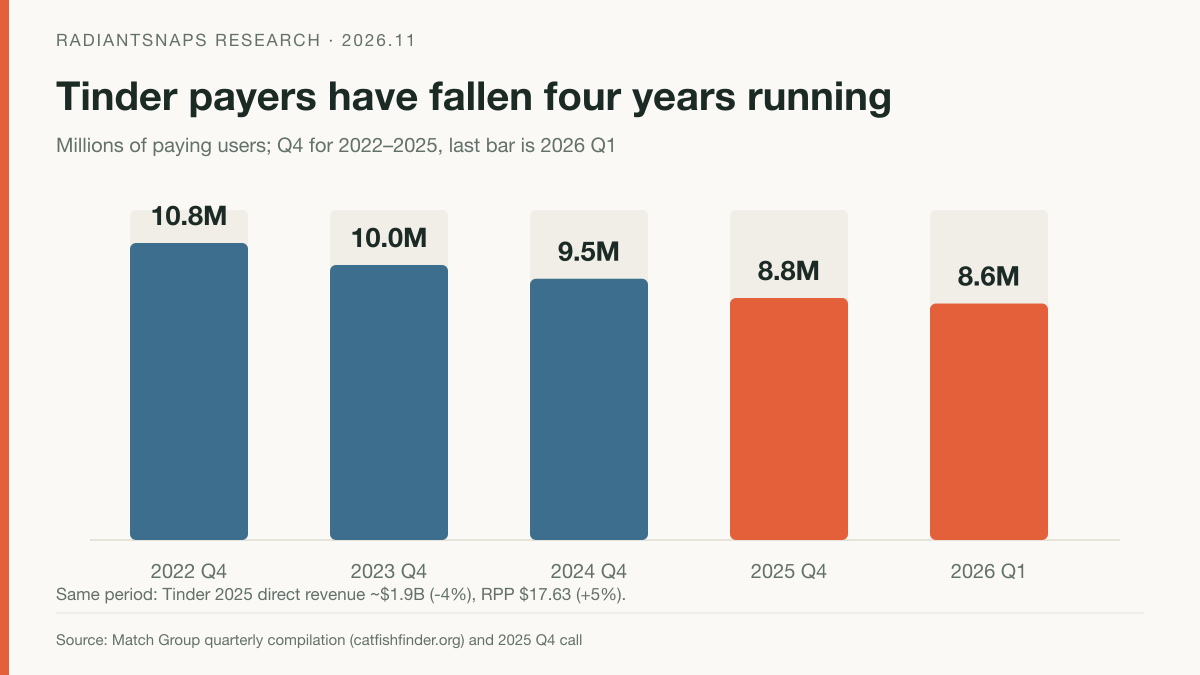
Source: Match Group 2025 Q4 earnings-call compilation and the quarterly series; the chart footnotes the source. "Fewer people, more from each" describes a combination of two disclosed numbers and contains no judgement about motive.
What "fewer people, more from each" actually means. Across four years paying users fell from 10.8M to 8.8M (and 8.6M by 2026 Q1), yet full-year direct revenue only fell 4% - far less than the headcount drop - while RPP rose 5%. Tinder's revenue is increasingly carried by a smaller group that each contributes more. Meanwhile Hinge paying users are up 17% and full-year revenue up 26%, so the group's growth engine is shifting; you can't read the whole company off the Tinder line alone.
That combination has plenty of neutral explanations that need no "deliberately" at all: subscription price rises, a larger share of higher tiers, the users who stayed being more engaged and more willing to pay, regional and currency mix, a product mix tilting toward pricier plans. It is also compatible with the forum feeling of being treated as a cash cow. Sit with the word "compatible": a set of financial ratios can describe an outcome, but it can't prove a motive and it can't rule one out either. Jumping straight from layer one to "so the platform keeps you single on purpose" needs evidence of intent, and there is no public source for that. We stop here and don't hand down a verdict for either side.
The dating app paywall question, and what Pew's 35% actually means
Another set of numbers gets drafted in to "prove paying works" or "prove the algorithm rewards payers". It comes from Pew Research Center's 2023-02-02 survey of 6,034 US adults.
| Metric | Figure | Meaning |
|---|---|---|
| Ever used a dating site / app and paid | 35% (of users) | roughly a third have paid |
| Over 30 / under 30 ever paid | 41% / 22% | nearly a 2x age gap |
| Men / women ever paid | 41% / 29% | a gender gap |
| Paid users positive / non-paid users positive | 58% / 50% | only an 8-point gap |
Source: Pew Research Center, 2023-02-02, 6,034 US adults; full URLs below.
These rows describe who pays and how payers rate the experience - not what paying caused. 58% versus 50% is eight points, and it's self-reported cross-sectional data: it could just as easily be self-selection ("people already having a good time are more willing to pay") as a sunk-cost effect ("having paid, I'm more invested and rate it more kindly"). Pew ran no randomised groups, so the direction of causation can't be read off it. 41% / 22% and 41% / 29% are likewise just distributions, not evidence that older people or men are favoured by an algorithm.
So using these numbers to argue either "paying gets you rewarded by the algorithm" or, just as lazily, "paying is a pure waste of money" makes the same mistake: reading a layer-one correlation as causation, then as a layer-three intention. Correlation isn't causation, and it certainly isn't motive - that's the line this article most wants to hold.
"Dating Apps Are Dying": the two comments everyone quotes
Layer two lives in the forums. The signature text of this round is the September 2026 r/technology long thread "Dating Apps Are Dying" (permalink: https://www.reddit.com/r/technology/comments/1wd8dnz/dating_apps_are_dying/), and two top comments get quoted constantly.
The two comments. u/Ragegasm wrote: "Tends to happen when your whole strategy is loot boxing loneliness through a swiping algorithm. I refused to play anymore after that realization." - the widely repeated "loot boxing loneliness through a swiping algorithm": treating a person's loneliness as the stake in a loot-box mechanic, and quitting once you see it. u/stormblaz's three-part version is more concrete: "They started locking good candidates behind paywall, ads every 3 swipes that open up a intrusive link, and on top allow bots to post onlyfan profiles looking to endorse their content behind a dating profile." - good matches behind a paywall, an ad every three swipes opening an intrusive link, and bots allowed to run OnlyFans funnel profiles.
Be clear: these are user quotes, layer two, unverified claims. They describe an experience precisely, but "paywall", "ad frequency" and "bots" here are things a user observed and attributed to platform strategy - not facts a regulator has established.
What the thread argues. Roughly: after Match Group consolidated the major products into a monopoly, the product's goal quietly shifted from "help you find someone" to "keep you swiping"; plenty of users miss the 2009-2013 OkCupid, with its long questionnaires you could read to see how someone reasoned, so the person on the other side felt like an actual person; the thread also spent a round correcting itself over whether Tinder and Bumble are owned by the same company. Translated into our frame: monopoly and product-shape changes are discussable industry background, "the goal was changed" is a claim, and "therefore the algorithm hides people" has already slid into layer three.
| Thread | Subreddit | Posted | Comments | Link |
|---|---|---|---|---|
| Dating Apps Are Dying | r/technology | 2026-09 (around 09-12) | signature long thread, count not recorded | https://www.reddit.com/r/technology/comments/1wd8dnz/dating_apps_are_dying/ |
| Did Tinder get much worse or did I age out of it? | r/OnlineDating | 17 days ago | 113 | https://www.reddit.com/r/OnlineDating/comments/1xcspgr/did_tinder_get_much_worse_or_did_i_age_out_of_it/ |
| Why is online dating in America so difficult? | r/OnlineDating | 22 days ago | 146 | https://www.reddit.com/r/OnlineDating/comments/1x8l2xz/why_is_online_dating_in_america_so_difficult/ |
| Several years of no matches/fake matches across every dating app I've tried | r/OnlineDating | 18 days ago | 39 | https://www.reddit.com/r/OnlineDating/comments/1xc51xy/several_years_of_no_matchesfake_matches_across/ |
| I do not miss dating apps whatsoever. | r/Bumble | 6 days ago | 636 | https://www.reddit.com/r/Bumble/comments/1xlvamt/i_do_not_miss_dating_apps_whatsoever/ |
Comment counts measure discussion volume, not incidence: a 636-comment "I don't miss dating apps at all" says a lot of people wanted to talk about quitting, and does not mean "the share of people with 636 comments uninstalled".
The regulatory timeline, graded by evidence
This is the section that most needs the layers kept apart. Grades first: A = a regulatory / judicial document or first-party filing, checkable; B = mainstream media reporting, awaiting document confirmation; C = second-hand compilation, defer to court and FTC documents; D = user complaint / forum claim, not verified by a regulator.
| Date | Event | Type | Grade | Status and source |
|---|---|---|---|---|
| 2024 | Class action against Match Group over "gamification addiction" | Litigation | B | Per Straight Arrow News, plaintiffs voluntarily withdrew that December; withdrawal is neither a finding of no liability nor proof the claim was true |
| 2025-08 | FTC and Match: $14M settlement over the "six-month guarantee / cancellation flow" | Regulatory settlement | C | Per second-hand compilation; defer to court and FTC documents |
| 2026-03 | FTC and Match: $0 settlement over sharing roughly 3 million users' photos and location data with a third-party face-recognition firm, with multi-year privacy oversight | Regulatory settlement | B | Straight Arrow News; the subject is privacy data sharing, not algorithmic matching |
| 2026 | Tinder: $60.5M settlement over charging over-30s more (about 268,000 California users; Tinder denies wrongdoing) | Litigation settlement | C | Per second-hand compilation, defer to court documents; denying wrongdoing isn't admitting the claim |
| 2026-10 | Users complain to the FTC about Hinge "algorithmic manipulation, artificial scarcity, pay-to-play" | User complaint | D | Straight Arrow News, which quotes an FTC lawyer saying such complaints may not be FTC-verified |
Note on the $14M and $60.5M lines: they come from second-hand compilations in the fact pack, which have no single checkable document URL, so we don't fabricate a link and simply mark them "per public reporting, defer to court and FTC documents".
The settlements you can verify are about other things. Line the rows up and a gap appears: the ones you can attach a dollar figure or an oversight clause to are "cancellation flow", "photo / location data sharing" and "age-based pricing" - billing, privacy and differential pricing, all consumer-protection territory. "The algorithm deliberately keeps you single" has no matching regulatory finding to date. The 2026-03 $0 settlement with privacy oversight is a real regulatory action (layer one); "artificial scarcity" in a user complaint is a layer-two claim; the two cannot "confirm" each other. Treating a privacy settlement as "the algorithm was caught cheating" is exactly the leap this article is built to avoid.
For contrast, here's what a genuinely checkable official document looks like: US Senate Report 119-58 (2025-09-02, on the official govinfo domain) records that in 2024, 59,000+ consumers reported romance-scam losses of nearly $1.2 billion to the FTC, with a median loss of $2,000. It has a report number, an official domain and line-by-line verifiability - and it still isn't about "the algorithm hiding people". Put it next to a forum screenshot and the distance between "a checkable official document" and "a top-voted comment" becomes obvious.
One last class of figures we don't use: "1.8M / 1.847M profiles analysed", "272% more matches", "90% of first impressions come from the photo", "78% user burnout" and similar circulate widely, sourced to AI-dating-photo SEO pages quoting each other with no published methodology or original dataset. None goes into a table here. Naming them is precisely what makes every number we do allow into a table stand up to a follow-up question.
Why we reject "hack the algorithm" subscriptions
The fact pack's industry timeline notes that after the October 2026 FTC complaint about Hinge, Reddit filled up with "am I being punished by the algorithm" and "paying too much means fewer matches" strategy posts, plus long posts about "only subscribing in short bursts so you don't get treated as a cash cow". Tricks like timing your renewal, subscribing at the start or end of the month, or pausing a few days and coming back are all over the forums - the whole "pay to play dating apps" grievance turned into a set of hacks.
We explicitly reject treating any of these as a working strategy. They only reflect user distrust (layer two), with no verifiable evidence of effect: no public data shows short subscriptions change exposure weighting, and no platform document says a renewal date triggers de-ranking. Treating an unobservable mechanism as a switch you can flip uses the exact same reasoning as the conspiracy it's trying to beat - inferring an invisible intent backwards from an outcome.
The more practical problem is opportunity cost. The half hour spent researching renewal timing could have gone into retaking one front-facing photo, swapping a hollow profile line for a concrete one, or changing "free sometime?" into "Thursday evening or Saturday afternoon, coffee?". So the conclusion is short: put your budget and effort on the side you control - photos, profile, messages, the invitation to meet. None of those four requires guessing what the algorithm is thinking, and you can observe the effect of each one yourself.
What a year of subscriptions actually costs
Having looked at "how the platform charges you", look at "how you spend". Every price below is a real figure shown on radiantsnaps.com, a brand's own pricing fact from a different source than the filings and Pew data above - don't read them as one dataset.
| Spend | Site price | Annualised | What you get | Nature |
|---|---|---|---|---|
| Standard monthly | $29 / month | $29 x 12 = $348 / year | 110 photos / month, valid 31 days | recurring subscription, renews each cycle |
| Premium monthly | $39 / month | $39 x 12 = $468 / year | 210 photos / month, valid 31 days, marked Most Popular | recurring subscription, renews each cycle |
| One-time Basic | $20 / 20 photos | $20 once | one set of photos, valid 365 days | one-off purchase, keep and reuse |
| One-time Standard | $40 / 100 photos | $40 once | one set of photos, valid 365 days | one-off purchase, keep and reuse |
The one-time tiers come from the site's page dictionary; check the checkout page for the current photo count, validity and price.
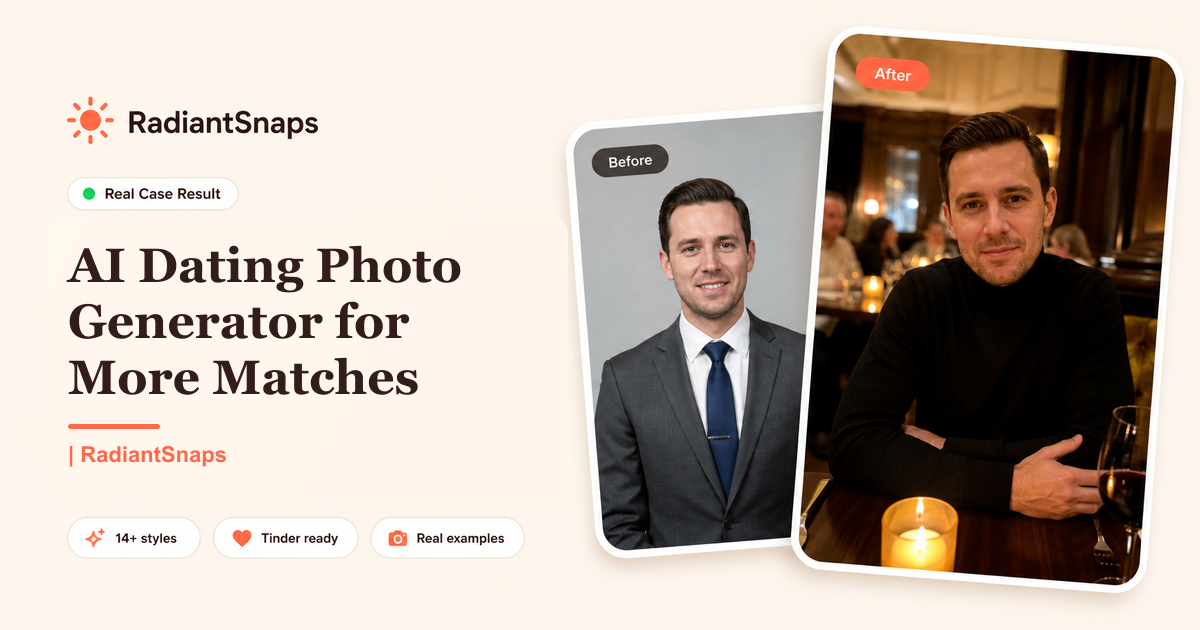
Image: a public layout asset from the RadiantSnaps site, used for illustration only; product content and results are as currently shown on the site.
This table is not a "which is better value" pitch. Monthly and one-off serve different needs: someone who wants a steady supply of fresh photos fits the former, someone who wants one good set fits the latter; $348 / $468 and $20 / $40 don't replace each other. What the table is really for is a different question: which spending goes into an asset you control. A one-off purchase buys a set of photos you own, can download, and can carry to any platform - it isn't tied to one algorithm's exposure rules and doesn't vanish the month you stop paying. A subscription is, by nature, an ongoing relationship whose rules are set by whoever provides it.
Set that against the forum discussion and the deepest resentment about the dating app paywall isn't "I spent money", it's "I spent money and the control is still with someone else". So the thing worth auditing isn't the price level, it's whether the money bought "a benefit that can change at any time" or "something I can walk away with". To be clear: this isn't a rejection of any dating-app subscription - a subscription buys in-platform exposure and features, which is a different kind of value - and we aren't making the "should you renew" call for you, still less promising that changing how you spend will change your luck.
About RadiantSnaps: the side you actually control
Place it in the three-layer frame first: it belongs on "the side you control", not on "the side that changes the algorithm". The site's own positioning is "Turn casual selfies into standout dating profile pictures - without the AI look.", for Tinder, Bumble, Hinge, Feeld, Raya and similar apps. RadiantSnaps does one narrow thing: a one-off, low-friction improvement to variables you control - upload a clear selfie, pick a style, images in minutes, with better lighting, framing and background while you stay recognisable.
| Item | Site fact |
|---|---|
| Free tier | $0, 3 AI-generated photos; the homepage says "No credit card required to start" |
| Monthly | Standard $29 / month (110 photos / month, valid 31 days), Premium $39 / month (210 photos / month, marked Most Popular) |
| One-time tiers | Basic $20 / 20 photos, Standard $40 / 100 photos, Premium $60 / 200 photos, valid 365 days; from the page dictionary, check the checkout page |
| Styles | The site says "25 photo styles" in one place and "26 styles / 312+ examples" in another, so read it as about 25-26, as currently shown on the site |
| Upload requirements | Good light, face forward, neutral or slight smile, no sunglasses, no hat, nobody else in frame |
| Privacy | The site says uploads aren't stored or viewed, generated photos are auto-deleted after 30 days; payments handled by Stripe |
| Refunds | No standard refund because AI compute costs are high; for a clear technical fault or artefacts, contact support@radiantsnaps.com for priority support |
| Photo-combination advice | One clear headshot + one full-body + one social / life + one hobby / personality, and "only keep photos that still look like you" |
This table is the site's pricing and FAQ facts - a brand's own claims, from a different source than the Pew / filing data above, and not to be mixed with them.
The boundary has to be explicit: it doesn't change the algorithm, doesn't guarantee a match and doesn't replace a subscription. A photo affects first impressions and the odds of being opened properly; it doesn't fix reply speed or someone else's interest, and it doesn't say "Thursday evening, coffee?" for you. It can't be used to bypass a platform's Face Check or human verification, can't change your face, can't turn you into someone else, and must never be used with any AI tool to fabricate another person's identity or invent a "you" who doesn't exist. The core claim is one line: better lighting, framing and background while keeping you recognisable. Any "buy this and get a partner" line, whoever says it, conflicts with this article's three-layer frame.
The site also carries "Get 10x More Likes", "4.2M+ successful matches", "100,000+ users", case figures "Match Rate 12x / 13x" and "Profile Views 14x", and a Bumble landing page "94% can't tell AI". All of these are website marketing claims with no third-party audit or published methodology. We don't put them in any data table and don't promise any multiple from them; they're the brand speaking about itself, not verifiable facts.
If all you want is to get "opened properly" right first, start with the free tier: go to radiantsnaps.com, use the 3 free photos to generate a set, mix it with real snapshots, run the three-second recognition test, and only then decide whether to continue. The flow is on the /generate page and the full tier list on /pricing.
A checklist you can actually follow
- Layer first. Tag every number or claim you see as 1 filing fact / 2 user claim / 3 unverifiable inference, and don't let layer three into your judgement.
- Audit the subscriptions. List every dating-related subscription and actual charge from last year, and ask one question only: "did this buy a benefit that can change at any time, or something I can walk away with?"
- Stop hacking the algorithm. Delete the "time your renewal" and "short subscriptions to reset your weight" tactics that have no verifiable effect, and move that time to the next step.
- Retake the photos. To the standard of face forward, good light, no sunglasses or hat, only you in frame, assemble the four - clear headshot + full body + social / life + hobby / personality; you can use the 3 free photos at radiantsnaps.com to fill a set, mixed with real snapshots, not one uniform tone across the board.
- Run the three-second recognition test. Show a friend for three seconds and ask "could you pick me out across a cafe table"; replace anything that fails, don't leave a whole set with an AI sheen.
- Rewrite the profile and the opener. Swap the empty line for a concrete one, swap "you around?" for an invitation with a time and a place, e.g. "Thursday evening or Saturday afternoon, coffee?".
- Track only what you can observe. Whether photos get opened more often, whether messages get a specific reply, whether the invitation lands; don't track "is the algorithm throttling me today".
- Accept the boundary. Whether they reply, how the platform ranks you, whether it clicks - none of that is on your console. Set the standard at "I did my side properly", not "this one has to work".
Sources and caveats
Every source cited, tagged. The categories - "filings", "regulatory document", "media reporting", "user complaint", "brand's own" - map to the three-layer frame above; don't read them as one pile.
| Category | Source | URL | Status |
|---|---|---|---|
| Filings / financial data | Match Group 2025 Q4 earnings-call compilation | https://finance.biggo.com.tw/quote/MTCH/earnings-call/US_MTCH_2026-02-03 | Authoritative second-hand compilation, not the original audited statements |
| Filings / financial data | Quarterly series compilation | https://catfishfinder.org/dating-app-statistics/ | Second-hand compilation |
| Authoritative survey | Pew Research Center, Key findings about online dating in the U.S. (2023-02-02, 6,034 US adults) | https://www.pewresearch.org/short-reads/2023/02/02/key-findings-about-online-dating-in-the-u-s/ | First-party survey |
| Authoritative survey | Pew Research Center, The Who, Where and Why of Online Dating in the U.S. | https://www.pewresearch.org/internet/2023/02/02/the-who-where-and-why-of-online-dating-in-the-u-s/ | First-party survey |
| Regulatory document | US Senate Report 119-58 (2025-09-02, official govinfo domain) | https://www.govinfo.gov/content/pkg/CRPT-119srpt58/html/CRPT-119srpt58.htm | First-party official document, used here only as a "checkable document" contrast, not as a basis for conclusions |
| Media reporting | Straight Arrow News: singles push regulators to crack down on dating-app algorithms | https://san.com/cc/they-want-money-pure-and-simple-singles-push-regulators-to-crack-down-on-dating-app-algorithms | Second-hand reporting; includes the FTC lawyer's "complaints may not be FTC-verified" note |
| User complaint / forum thread | r/technology "Dating Apps Are Dying" | https://www.reddit.com/r/technology/comments/1wd8dnz/dating_apps_are_dying/ | User claim, unverified; 2026-11-09 snapshot |
| User complaint / forum threads | r/OnlineDating and r/Bumble top threads this month (see the forum table above) | https://www.reddit.com/r/OnlineDating/ | User claims; votes / comment counts are snapshot values |
| Brand's own | RadiantSnaps site (home / generate / pricing) | https://radiantsnaps.com/ | Site pricing, FAQ and marketing claims, all brand's own; one-time tiers as per the checkout page |
Extra caveats: all "N days ago" are relative to 2026-11-09; every vote and comment count is a snapshot value measuring discussion volume, not incidence, and will keep changing. The 2025-08 $14M settlement and the 2026 Tinder $60.5M settlement come from second-hand compilations with no single checkable document URL in the fact pack, so they aren't given a standalone link and are marked "per public reporting, defer to court and FTC documents". Quora's Dating Apps topic is thick with promotional and spam accounts and stolen-photo scam profiles, so we use it only for first-hand phrasing, never as sentiment data or a factual source. We don't use "1.8M / 1.847M profiles analysed / 272% more matches / 90% of first impressions from the photo / 78% or 79% burnout / 89% photo mismatch" and similar figures with no traceable original study. So, are dating apps rigged? The filings show fewer payers and more revenue per payer; the complaints show distrust; neither one shows intent - and the only side you can actually improve is your own.
Frequently Asked Questions
- Are dating apps rigged - has any regulator actually ruled on it?
- No. As of writing, the public actions you can attach a dollar amount or an oversight clause to cover cancellation flows, privacy data sharing and age-based pricing. The FTC complaint Hinge users filed about "algorithmic manipulation, artificial scarcity, pay-to-play" remains a complaint, and the FTC lawyer quoted by Straight Arrow News says such complaints may not be FTC-verified. Writing "someone complained" as "the regulator has ruled" is the exact leap this article is built to avoid.
- Does the dating app paywall keep you single, or is that just correlation?
- The "algorithm keeps you single" story isn't supported by a checkable document. What we have is a layer-one correlation - Pew's 58% versus 50% positive experience among payers and non-payers, an eight-point gap from self-reported cross-sectional data - and layer-two complaints. Neither establishes causation, let alone a deliberate design. Paying more doesn't prove a reward, and paying at all doesn't prove a trap; we won't turn a survey gap into a verdict about intent.
- Do short subscriptions that "hack the algorithm" actually work?
- No verifiable evidence says they do. They show up in strategy threads after the FTC complaint and reflect distrust of the algorithm (layer two), not an observed mechanism. No platform document says renewal timing triggers de-ranking, and no public data shows short subscriptions change exposure weighting. Rather than guess at an invisible switch, spend the same time on photos, profile, the opening messages and a concrete invitation - those are things whose effect you can actually watch.
- Is Match Group paying users declining proof they're squeezing the people left?
- No. That's layer one, and it describes an outcome, not a motive. Price rises, a higher share of premium tiers, more engaged remaining users, regional and currency mix, and the growth engine shifting to Hinge all explain the same numbers without any "deliberately". It's compatible with the suspicion but doesn't confirm it - and equally doesn't clear the platform. What's missing is evidence of intent, for which there is no public source.
- Is a one-off photo pack better value than a subscription, and can it replace one?
- Neither. They serve different needs: monthly suits someone who keeps wanting fresh photos, a one-off suits someone topping up one set, and we make no "better value" call and don't believe changing how you spend changes your luck. A one-off buys a photo asset you can carry to any platform; a subscription buys in-platform exposure and features. Neither changes the algorithm or guarantees a match. Whether to renew is your call, on your own needs.